

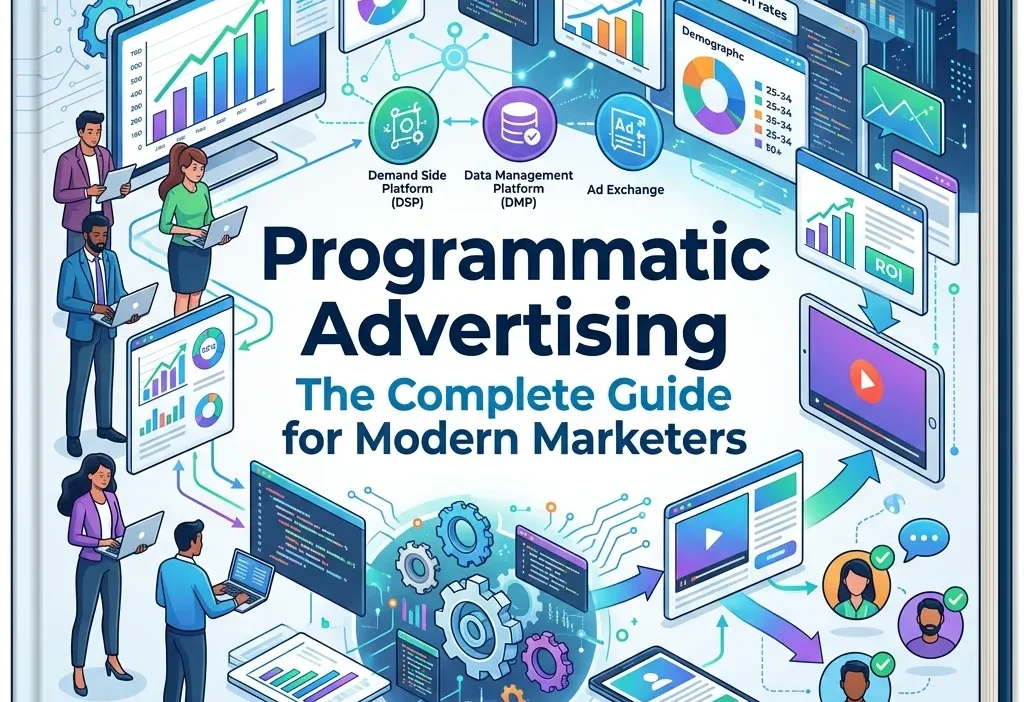
Programmatic advertising has become the backbone of modern digital marketing, using automated, data-driven bidding to place ads in front of the right audience at the right moment. This guide breaks down how the technology works, the different buying models available, the benefits and challenges brands face, and where the industry is headed next.
What Is Programmatic Advertising?
Programmatic advertising is the automated buying and selling of digital ad inventory using software and real-time data, replacing the manual insertion orders and human negotiations that defined traditional media buying. Instead of a media buyer emailing a publisher to reserve ad space, this approach uses algorithms to evaluate an available ad impression, bid on it in real time, and serve the winning creative — all within milliseconds, as a webpage loads.
This shift has made programmatic advertising the dominant method of buying digital ads today, powering the majority of display, video, audio, and connected TV spend across the industry. What once required teams of media buyers manually negotiating placements across dozens of publishers can now happen automatically, at a scale no human team could manage alone.
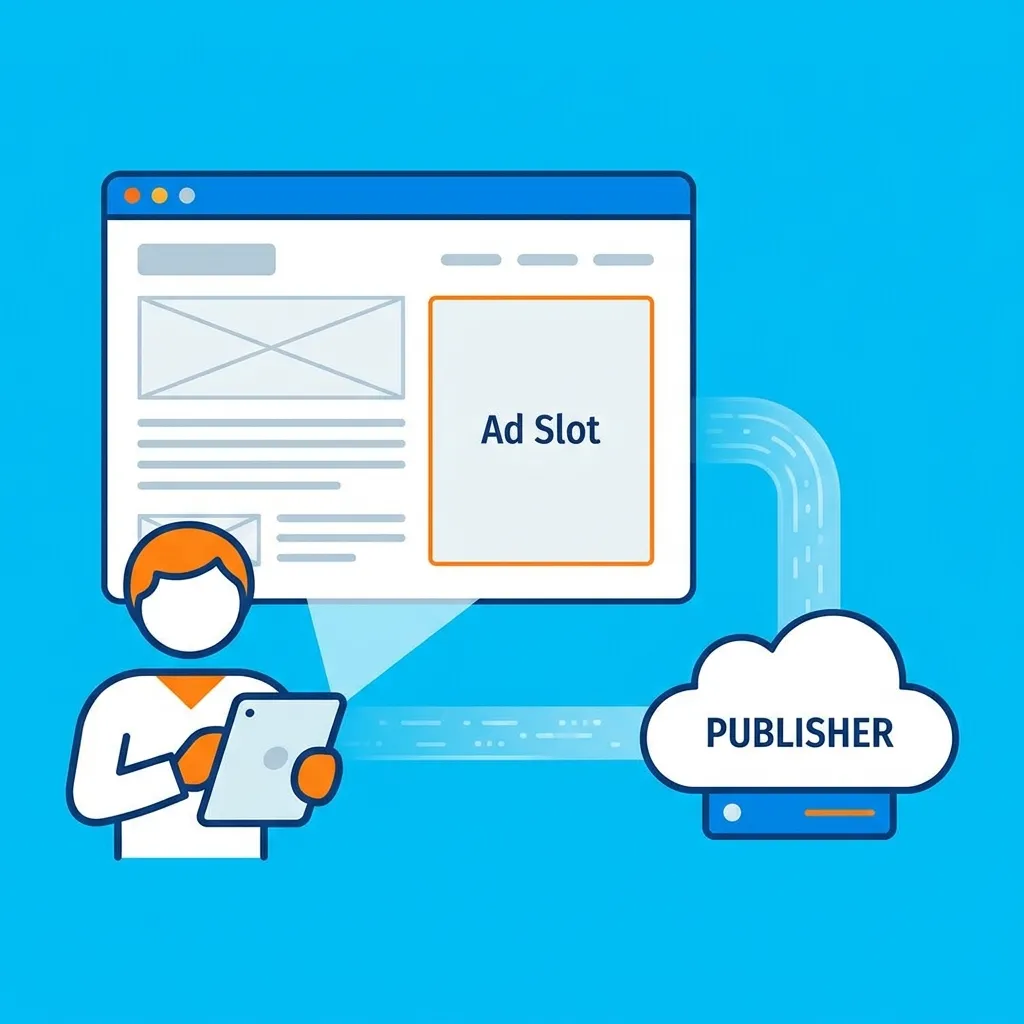
At its core, the system relies on a real-time auction connecting advertisers and publishers through several key technology layers:
- Demand-Side Platforms (DSPs): Software that advertisers use to buy ad inventory across multiple exchanges, setting targeting parameters, budgets, and bid strategies for a campaign.
- Supply-Side Platforms (SSPs): Software that publishers use to sell their available inventory, connecting it to multiple demand sources to maximize revenue.
- Ad Exchanges: The digital marketplaces where DSPs and SSPs meet, running the real-time auctions that make the whole process possible.
- Data Management Platforms (DMPs): Systems that collect and organize audience data, feeding it into campaigns to improve targeting precision.
When a user visits a webpage, an ad request is sent to an exchange, multiple advertisers bid on that specific impression based on the user’s data profile, and the highest bidder’s ad is served — a process that happens in under 100 milliseconds, entirely invisible to the person browsing. This entire sequence, repeated billions of times a day across the internet, is what most people mean when they refer to programmatic advertising as a category.
A Brief History of How the Industry Got Here
Before automated buying existed, digital ad space was sold much like print or television — through direct relationships, insertion orders, and manual negotiation between an advertiser’s media team and a publisher’s sales team. As the number of websites exploded in the 2000s, this manual process couldn’t keep up with the sheer volume of available inventory, and much of it went unsold.
Real-time bidding technology emerged to solve that inefficiency, giving publishers a way to auction unsold inventory automatically and giving advertisers access to a far larger pool of placements than they could ever negotiate individually. Over the following decade, the technology expanded well beyond simple banner ads, eventually covering video, audio, and connected TV, and evolving from a niche efficiency tool into the default way most digital advertising gets bought and sold.
Types of Buying Models
Not all automated ad buying follows the same purchase structure. Understanding the different models helps marketers choose the right approach for their goals.
Real-Time Bidding (RTB)
Real-time bidding is the most common form of programmatic advertising, where ad impressions are auctioned individually and sold to the highest bidder in an open marketplace. This model gives advertisers access to a huge volume of inventory across many publishers, making it efficient for scaling campaigns quickly and reaching broad audiences without manual outreach.
Private Marketplace (PMP)
A private marketplace is an invite-only version of the same auction system, where a publisher offers premium inventory to a select group of advertisers before it goes to the open exchange. This gives brands running automated campaigns more control over placement quality and brand safety than the open marketplace typically allows.
Programmatic Direct
Programmatic direct allows advertisers to buy guaranteed inventory directly from a publisher at a fixed price, without an auction. This model combines the automation benefits of the broader ecosystem with the certainty of a traditional direct buy, which many premium publishers prefer for their top-tier ad slots.
Preferred Deals
Preferred deals sit between PMP and open auction buying, giving select advertisers first access to inventory at a fixed price before it’s offered to the broader marketplace, without the exclusivity commitment of a full private marketplace arrangement.
Key Benefits of Programmatic Advertising
Marketers have shifted budgets toward this approach for several concrete reasons:
Efficiency at scale. Automated buying eliminates the manual work of negotiating individual placements, letting a single campaign run across thousands of sites and apps simultaneously without additional staffing.
Precise audience targeting. Because the system relies on data signals — demographics, browsing behavior, location, and purchase intent — brands can reach highly specific audience segments rather than buying broad, untargeted placements.
Real-time optimization. Platforms adjust bids and creative delivery on the fly based on performance data, meaning underperforming placements can be paused within hours rather than waiting for a campaign to end.
Transparency and measurement. Modern platforms provide granular reporting on impressions, clicks, conversions, and spend, giving marketers far more visibility than legacy media buying ever offered.
Cross-channel reach. The technology now spans display, video, audio, native, and connected TV, allowing brands to run a unified strategy across formats from a single dashboard.
Common Challenges in Programmatic Advertising
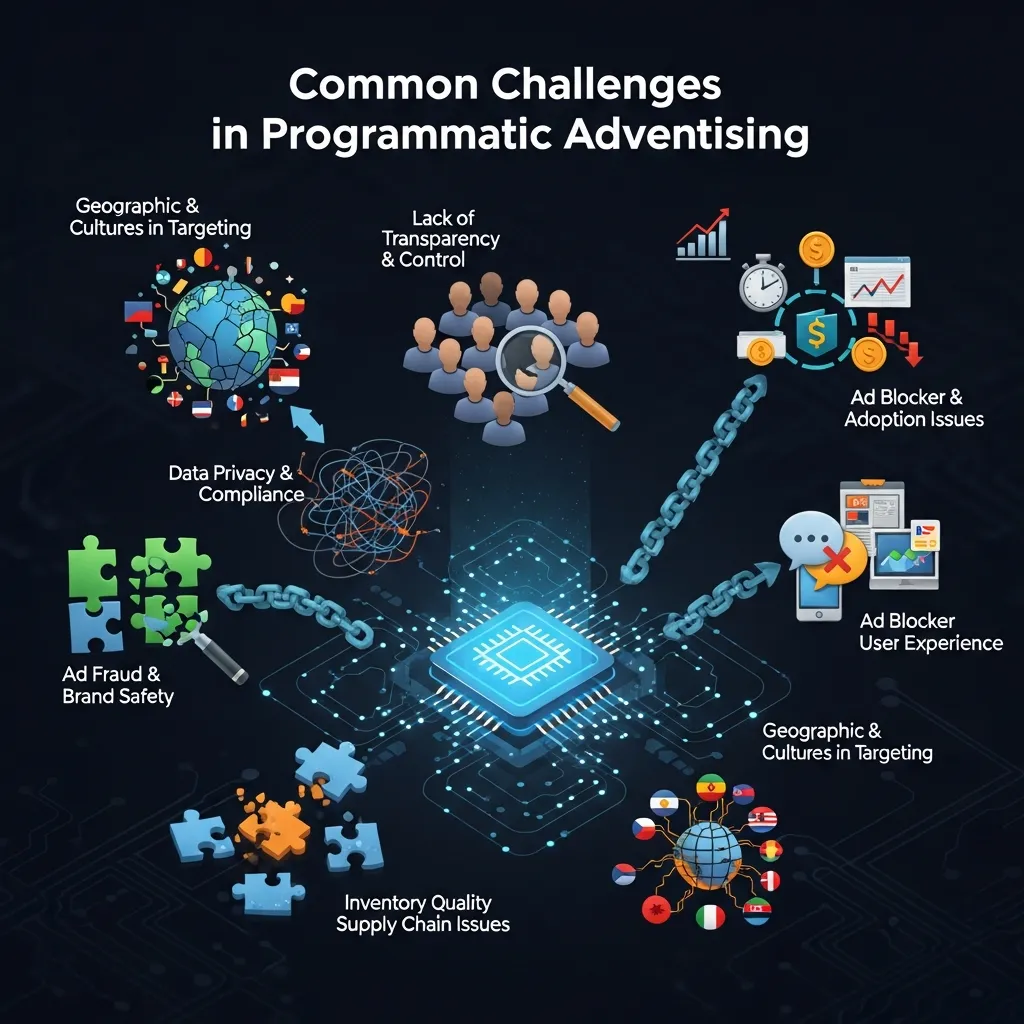
Despite its advantages, this approach comes with real challenges that marketers need to manage carefully.
Ad fraud. Because the ecosystem operates at such scale and speed, it has historically been vulnerable to bot traffic and fraudulent impressions, making fraud detection tools an essential part of any serious buying strategy.
Brand safety. Automated placement means ads can occasionally appear next to inappropriate or low-quality content if campaigns aren’t configured with strict exclusion lists and content categories.
Data privacy regulations. The industry has historically relied heavily on third-party cookies and user tracking, and evolving privacy laws are forcing a rebuild of targeting methods around consent-based and contextual data instead. For a deeper look at how the space is adapting, this guide on privacy-first advertising covers the shift toward trust-focused strategies more broadly.
Complexity. With so many platforms, data sources, and buying models involved, the space can be overwhelming for marketers new to it, often requiring dedicated expertise or agency support to run effectively.
The Psychology Behind Effective Campaigns
Beyond the technology, successful programmatic advertising still depends on understanding how audiences actually respond to ads. Precise targeting only pays off if the creative and messaging resonate once an ad is served, which is why many marketers pair their media buying strategy with research into consumer psychology and decision-making triggers. For a closer look at that side of the equation, this guide to programmatic advertising psychology explores how automated targeting and human behavior intersect in practice.
Best Practices for Running Campaigns
Getting the most out of this channel requires more than just launching a campaign and letting the algorithm run. A few practices consistently separate high-performing programmatic advertising campaigns from underperforming ones:
- Set clear KPIs before launch. Define whether the goal is awareness, traffic, or conversions, since each requires a different bidding strategy.
- Use first-party data where possible. As third-party cookies phase out, first-party data gives campaigns a more durable targeting foundation.
- Build strong exclusion lists. Protect brand safety by proactively blocking low-quality domains and content categories from your inventory pool.
- Test creative variations. The infrastructure makes A/B testing easy — use that flexibility to continuously refine ad creative based on real performance data.
- Monitor fraud metrics closely. Regularly audit viewability and fraud scores to make sure your spend is reaching real, engaged users rather than bots.
- Layer in frequency caps. Prevent ad fatigue by limiting how often the same user sees your creative within a given time window.
- Align creative with placement context. Ads that visually and tonally match the surrounding content tend to perform better than generic creative dropped into any available slot.
For a more complete operational checklist, this guide on programmatic advertising best practices walks through campaign setup in more depth.
Programmatic Advertising Across Formats
This technology is no longer limited to banner ads on websites. It now spans nearly every digital ad format:
- Display advertising: The original use case for automated buying, still widely used across websites and apps.
- Video advertising: The technology now powers pre-roll, mid-roll, and outstream video placements across publishers and streaming platforms.
- Connected TV (CTV): One of the fastest-growing areas of the space, bringing automated buying to streaming services and smart TVs.
- Audio advertising: Podcasts and streaming music platforms increasingly sell inventory through these automated channels.
- Native advertising: The same infrastructure can also power native placements that blend into a publisher’s content feed.
Measuring Success and Common Metrics
Because so much of this ecosystem is automated, measurement plays an outsized role in determining whether a campaign is actually working. Marketers typically track a combination of delivery metrics — impressions, viewability rate, and click-through rate — alongside deeper performance indicators like cost per acquisition, return on ad spend, and post-view conversion rates. Attribution remains one of the trickier parts of the equation, since a single conversion path often crosses multiple devices, formats, and platforms before a purchase happens. Many teams now rely on multi-touch attribution models or platform-provided lift studies to get a clearer picture of which placements are actually driving results, rather than relying on last-click data alone.
The Future of Programmatic Advertising

Several trends are shaping where this industry is headed next. Artificial intelligence is playing an increasingly central role, helping platforms optimize bidding strategies and creative delivery in real time with far more precision than earlier rule-based systems could achieve. At the same time, the industry-wide shift away from third-party cookies is pushing the space toward contextual targeting, first-party data partnerships, and privacy-compliant identity solutions.
Connected TV is also expected to be one of the biggest growth areas over the next few years, as more viewing shifts to streaming platforms that support automated ad buying. Retail media networks are emerging as another major growth channel, letting brands buy ad placements directly on e-commerce sites using first-party purchase data that’s often more predictive than traditional browsing signals. Together, these shifts suggest that programmatic advertising will keep expanding in scale while becoming more privacy-conscious and AI-driven at the same time.
Industry Standards and Resources
Because this ecosystem involves so many interconnected platforms and data flows, the industry relies on shared technical standards to keep everything functioning smoothly. The IAB Tech Lab publishes widely adopted specifications for ad delivery, measurement, and privacy compliance, and serves as a useful reference for marketers and developers working directly with this infrastructure.
Conclusion
Programmatic advertising has fundamentally changed how digital ads are bought and sold, replacing manual negotiation with automated, data-driven precision at massive scale. While challenges like ad fraud, brand safety, and shifting privacy regulations require ongoing attention, the efficiency and targeting power of this approach make it a core part of nearly every modern marketing strategy. Understanding how the technology works — and following proven best practices — is what separates brands that get real value from programmatic advertising from those that simply spend money on it.
Frequently Asked Questions
1. What is programmatic advertising in simple terms?
Programmatic Advertising is the automated buying and selling of digital ad space using software and real-time bidding. Instead of relying on manual negotiations, advertisers use automated systems to purchase ad placements and reach relevant audiences efficiently.
2. How is Programmatic Advertising different from traditional advertising?
Traditional advertising relies heavily on manual insertion orders, direct negotiations, and fixed placements. Programmatic Advertising uses algorithms and automated platforms to buy and place digital ads in real time based on audience, inventory, and campaign data.
3. What platforms are involved in Programmatic Advertising?
The main platforms include demand-side platforms (DSPs), supply-side platforms (SSPs), ad exchanges, and data management platforms (DMPs). Together, these technologies help Programmatic Advertising automate the buying, selling, targeting, and optimization of digital advertising inventory.
4. Is Programmatic Advertising only used for display ads?
No. Programmatic Advertising now supports multiple formats, including display, video, audio, native advertising, and connected TV (CTV). This allows advertisers to reach audiences across different digital channels through automated media buying.
5. What is real-time bidding in Programmatic Advertising?
Real-time bidding (RTB) is an auction-based buying model used in Programmatic Advertising. Individual ad impressions are auctioned among advertisers, with the winning bid typically selected within milliseconds as a webpage or digital content loads.
6. How does audience targeting work?
Audience targeting uses data signals such as demographics, browsing behavior, interests, and location to identify relevant audience segments. In Programmatic Advertising, these signals help advertisers deliver ads to users who are more likely to engage with their campaigns.
7. What is ad fraud in Programmatic Advertising?
Ad fraud involves fraudulent activity such as bot traffic, fake impressions, or invalid clicks that can increase advertising costs without reaching genuine users. Because of this, fraud detection and verification tools are important parts of effective Programmatic Advertising campaigns.
8. Will the removal of third-party cookies affect Programmatic Advertising?
Yes. Changes to third-party cookies are influencing how advertisers collect and use audience data. As the industry evolves, Programmatic Advertising is increasingly incorporating contextual targeting, first-party data, and other privacy-conscious approaches.
9. What is a private marketplace?
A private marketplace (PMP) is an invite-only digital advertising auction where selected advertisers can access premium inventory. PMPs can give Programmatic Advertising campaigns more control over where ads appear and which publishers or inventory sources are included.
10. How much does Programmatic Advertising typically cost?
Costs vary depending on the advertising format, audience targeting, competition, publisher inventory, and campaign objectives. Programmatic Advertising is commonly priced using cost per thousand impressions (CPM), although other pricing models may also apply.
11. Is Programmatic Advertising suitable for small businesses?
Yes. Small businesses can use Programmatic Advertising when they have clear targeting goals and an appropriate budget. Working with an experienced agency or advertising platform can make campaign setup, audience targeting, optimization, and measurement easier.
12. What’s the biggest growth area in Programmatic Advertising?
Connected TV (CTV) is one of the major growth areas within Programmatic Advertising as more consumers shift from traditional television toward streaming services. Programmatic CTV allows advertisers to combine television-style video content with digital targeting and measurement capabilities.
[…] For publishers and marketers, understanding how advertising works is equally important. You can learn more through Programmatic Advertising: The Complete Guide. […]