
An affiliate marketing blog is one of the most effective ways to build long-term online income because it combines helpful content, search traffic, and product recommendations in one place. In this guide, you will learn affiliate marketing for beginners, how to start an affiliate marketing blog, how to follow affiliate marketing step by step, how to make money with affiliate marketing, what affects your affiliate marketing income, how to choose the best niches for affiliate blog, how to find the best affiliate networks, how to improve your affiliate marketing tips, and how to get traffic from the right affiliate marketing traffic sources. This is a complete beginner affiliate marketing guide designed to help you create a strong content foundation for your website.
What Is an Affiliate Marketing Blog?
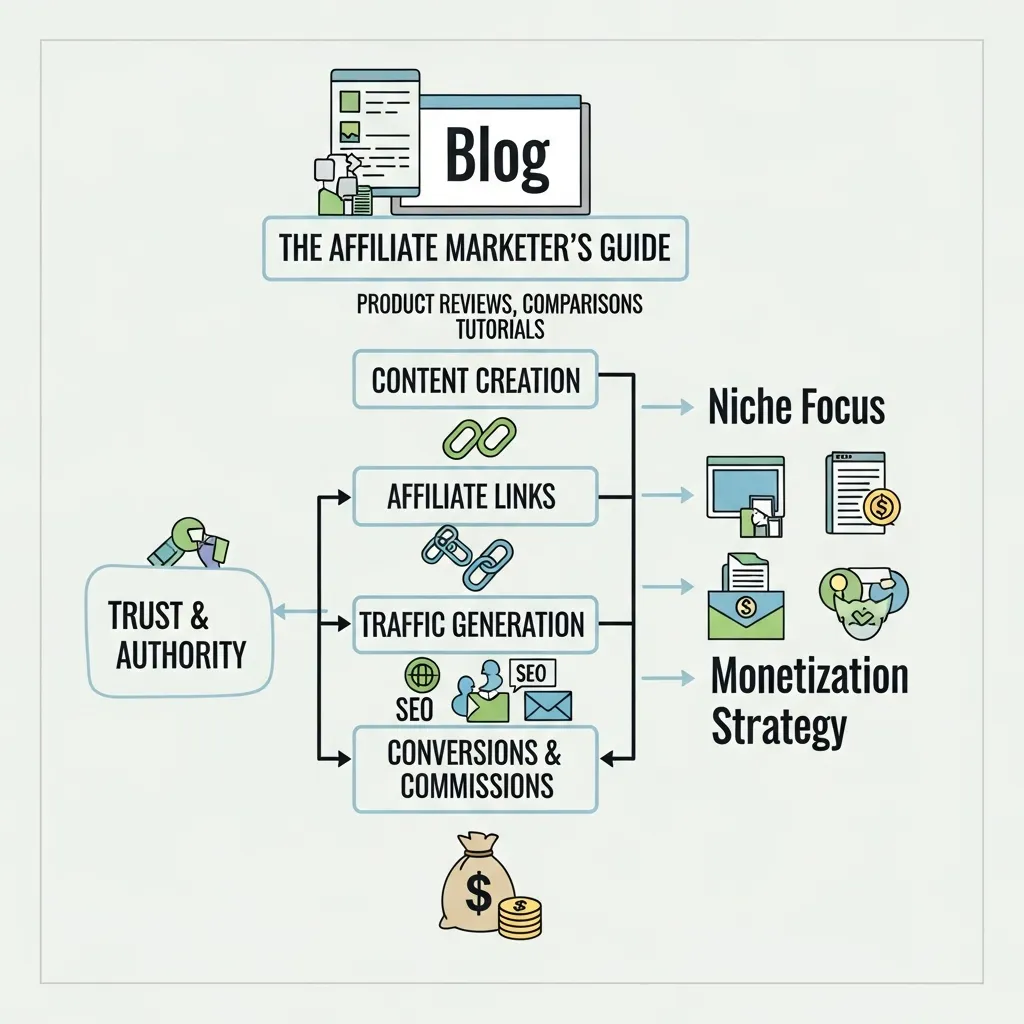
An affiliate marketing blog is a website where you publish useful content and promote products or services through affiliate links. When a reader clicks your link and completes a purchase or another desired action, you earn a commission.
The blog does not sell products directly. Instead, it acts as a bridge between the user and the merchant. Your job is to educate, compare, review, and guide readers so they can make better decisions. That is why affiliate blogs work so well: they solve problems first and monetize second.
A strong affiliate blog can cover many types of content, such as:
- Product reviews
- Comparison articles
- Tutorials
- How-to guides
- List posts
- Buying guides
- Resource pages
- Recommendation posts
- Beginner-friendly educational content
The reason this model is powerful is simple. People search online before buying. If your content helps them at that moment, your blog can earn trust and commissions over time.
Why an Affiliate Marketing Blog Is Still One of the Best Online Business Models
Many people ask whether blogging still works in a world full of social media, video content, and AI tools. The answer is yes—because search intent still exists.
When someone searches for “best budget laptop for students” or “best protein powder for beginners,” they already have buying intent. A well-written affiliate blog can capture that intent and guide the reader toward a purchase.
Here are the biggest advantages of building an affiliate marketing blog:
1. Low Startup Cost
Compared to many businesses, blogging is affordable. You need a domain, hosting, and content. That makes it one of the lowest-cost ways to start earning online.
2. Long-Term Traffic
A good article can bring traffic for months or even years. Unlike paid ads, organic blog content continues working after publication.
3. Passive Income Potential
Once articles rank and bring steady traffic, they can produce commissions without you being present every day.
4. Scalable Content Model
You can grow one article into hundreds. You can also expand into new categories, new keywords, and new affiliate networks.
5. Helpful and Ethical Business Model
You are not forcing people to buy. You are helping them make informed decisions. That makes affiliate marketing easier to build on trust.
Affiliate Marketing for Beginners: The Core Idea
For affiliate marketing for beginners, the main idea is easy to understand:
- Choose a niche.
- Create useful content.
- Join affiliate programs.
- Add relevant affiliate links.
- Drive traffic.
- Earn commissions.
The challenge is not understanding the concept. The challenge is doing the right steps in the right order.
Many beginners make the mistake of jumping straight to commissions without building a real content strategy. That usually fails. A blog needs trust, structure, and consistency. Without these, readers will not stay and search engines will not reward your pages.
A successful affiliate blog is built around three pillars:
- Audience intent: What is the reader trying to solve?
- Content quality: Is the article actually helpful?
- Monetization relevance: Does the affiliate product fit the content naturally?
If you get these three right, your blog has a real chance to grow.
How to Start Affiliate Marketing Blog Step by Step
If you want to know how to start affiliate marketing blog, follow this exact process.
Step 1: Choose a Specific Niche
Do not start with a broad topic like “lifestyle” unless you already have a content plan. Narrow niches perform better because they are easier to target and easier to monetize.
Examples:
- Fitness for beginners
- Home office tools
- Budget travel gear
- Parenting products
- Kitchen appliances
- Beauty for sensitive skin
- Digital tools for freelancers
A niche should be:
- In demand
- Monetizable
- Content-rich
- Not too broad
- Not impossible to rank in
The best niche is usually a topic you understand, can write about, or can research deeply.
Step 2: Research Search Intent
Before writing, understand what users really want when they search a keyword.
For example:
- “Best affiliate networks” = comparison and recommendation intent
- “How to make money with affiliate marketing” = beginner education intent
- “Affiliate marketing income” = earning potential and proof intent
- “Affiliate marketing traffic sources” = growth strategy intent
When you match the content with the intent, your pages become much more useful.
Step 3: Build Your Website
You need a clean, fast, mobile-friendly site. Your blog should have:
- Clear navigation
- Simple categories
- Easy-to-read fonts
- Internal linking
- SEO-optimized URLs
- About page
- Contact page
- Privacy policy
- Affiliate disclosure
A user should immediately understand what your site is about.
Step 4: Create Pillar Content and Supporting Posts
Your main pillar article should cover the topic deeply. Then create supporting articles around related subtopics.
For an affiliate blog, pillar and cluster content might include:
- Affiliate marketing blog guide
- Best affiliate networks
- Affiliate marketing traffic sources
- How to start affiliate marketing blog
- Affiliate marketing income for beginners
- Best niches for affiliate blog
- Affiliate marketing tips for higher conversions
This structure helps search engines understand topical authority.
Step 5: Join Affiliate Programs
After choosing your niche, join affiliate programs that fit your audience.
You may sign up for:
- Individual brand programs
- Affiliate networks
- Digital product marketplaces
- Recurring subscription programs
- E-commerce affiliate programs
Always choose products that truly match the topic. Promoting random products hurts trust.
Step 6: Publish Valuable Content
Do not publish thin content. Write articles that answer real questions, solve problems, and guide the reader toward a decision.
Useful article types:
- “Best tools for beginners”
- “Top 10 products for X”
- “How to use X”
- “X vs Y”
- “Best X for beginners”
- “Complete guide to X”
Step 7: Drive Traffic
Even the best content will not earn much without traffic. Focus on:
- SEO
- YouTube
- Social media
- Email marketing
- Guest posts
- Communities and forums
Step 8: Improve Conversions
Traffic is important, but conversions matter more. Your content must persuade naturally.
Use:
- Honest comparisons
- Clear product benefits
- Pros and cons
- Strong calls to action
- Tables and bullet summaries
- FAQs
- Trust signals
Step 9: Track and Improve
Use analytics to find which pages rank, which pages get clicks, and which pages earn revenue. Then update underperforming posts.
This is not a one-time business. It is a system.
Affiliate Marketing Step by Step: The Full Workflow
Here is the full affiliate marketing step by step process in a practical format.
1. Find a profitable topic
Look for keywords that combine:
- Search demand
- Commercial value
- Buyer interest
- Content possibility
2. Build content clusters
Create a group of articles around a central theme. This helps your site become more trustworthy.
3. Create a content calendar
Plan your posts in advance. Consistency matters.
4. Write for humans first
Never write only for SEO. Write for people who need a solution.
5. Add affiliate links strategically
Place links where readers naturally want more information, such as:
- Product mention sections
- Comparison tables
- Recommendation boxes
- End-of-article suggestions
6. Optimize for search
Use:
- Relevant headings
- Keyword variations
- Internal links
- Fast load speed
- Mobile-friendly design
- Clear meta titles and descriptions
7. Build trust
People click affiliate links when they trust the recommendation. Be honest about limitations.
8. Measure income and traffic
Understand where your traffic comes from and which pages make money.
9. Improve old content
Sometimes old content can outperform new content after an update.
10. Expand into multiple affiliate streams
Once your site grows, you can diversify income across several programs.
How to Make Money With Affiliate Marketing

Many beginners want to know exactly how to make money with affiliate marketing. The answer is simple in theory and strategic in practice.
You make money when:
- A reader trusts your recommendation
- A visitor clicks your affiliate link
- The merchant tracks that click
- The reader buys something or completes a conversion
- You receive a commission
Your money comes from the value you create before the sale.
The best affiliate content usually targets high-intent users. These people are already looking for a solution, so your article simply helps them choose.
Examples:
- A user searches for “best email marketing tools”
- They read your comparison article
- You explain which tool is best for beginners, small businesses, and advanced users
- They click your link and buy
- You earn commission
That is the basic model.
But making real money requires more than placing links. It requires:
- Keyword research
- Buyer intent content
- Good writing
- Honest positioning
- A relevant offer
- Traffic growth
- Conversion optimization
Affiliate income is usually not instant. At first, the earnings may be small. Over time, successful pages can bring strong results if they solve real problems.
Affiliate Marketing Income: What to Expect
One of the most searched topics is affiliate marketing income. People want to know how much they can earn.
The truth is that income varies widely. Some bloggers earn very little. Others earn thousands or even much more. The difference usually depends on these factors:
1. Niche choice
Some niches pay better than others.
Examples of higher-value niches:
- Software
- Finance
- Hosting
- Business tools
- Education
- Health products
- SaaS
- Technology
These often have stronger commission structures.
2. Traffic volume
More traffic usually means more clicks and more sales.
3. Conversion rate
A page with lower traffic but high conversion can outperform a page with lots of traffic and poor intent matching.
4. Commission rate
Some programs pay a small percentage. Others pay fixed amounts. Some offer recurring commissions.
5. Trust and authority
Readers buy more often from websites that feel credible.
6. Content quality
Clear, useful, and persuasive content converts better.
7. Email and retargeting systems
Blogs that capture email leads can earn more than blogs relying only on one visit.
A beginner should not expect huge income in the first few months. Instead, focus on building a site that can scale.
Think of affiliate income as the result of a system, not a lucky post.
Best Niches for Affiliate Blog
Choosing the best niches for affiliate blog is one of the most important decisions you will make.
A good niche should have:
- Audience demand
- Product availability
- Commission potential
- Content opportunities
- Long-term relevance
Here are some strong niche ideas.
1. Health and wellness
Examples:
- Weight loss support
- Fitness equipment
- Supplements
- Sleep products
- Home workout tools
This niche is huge, but it can also be competitive. You need a specific angle.
2. Technology
Examples:
- Laptops
- Accessories
- Software
- Productivity tools
- AI tools
- Web hosting
Tech is excellent for affiliate monetization because many products are high value.
3. Personal finance
Examples:
- Budgeting tools
- Credit-building tools
- Investing platforms
- Tax software
- Financial education
This is a strong niche, but content must be accurate and responsible.
4. Beauty and skincare
Examples:
- Makeup
- Skin products
- Hair care
- Sensitive skin solutions
- Grooming tools
This niche works well when the content is visual and problem-focused.
5. Home and kitchen
Examples:
- Small appliances
- Cleaning tools
- Storage products
- Home improvement tools
This niche is often buyer-friendly because people search for practical solutions.
6. Parenting and family
Examples:
- Baby products
- Educational tools
- Parenting resources
- Safety products
This niche can perform well if content is helpful and trustworthy.
7. Travel
Examples:
- Luggage
- Travel gear
- Booking tools
- Insurance
- Accessories
Travel can be powerful, especially with product review and destination content.
8. Online business
Examples:
- Hosting
- Email tools
- Design tools
- SEO tools
- Course platforms
This niche is popular because many affiliate products pay well.
The best niche is not always the biggest niche. Sometimes the best niche is the one where you can create consistent, useful content without burning out.
Best Affiliate Networks for Beginners and Growing Blogs
Finding the best affiliate networks is important because the network can affect product access, commissions, reporting, and ease of use.
Here are the main types of affiliate networks:
1. Large general networks
These provide access to many brands in one place. They are useful for beginners because you can find multiple offers in one dashboard.
2. Brand-specific programs
Some companies run their own affiliate programs. These can offer higher commissions or more direct support.
3. SaaS and subscription programs
Software companies often pay recurring commissions, which can be very profitable over time.
4. Marketplaces
Some platforms allow you to promote digital products, courses, or downloadable resources.
5. Retail networks
These are useful for product-focused blogs, especially in consumer niches.
When choosing a network, consider:
- Commission rate
- Cookie duration
- Payout threshold
- Payment methods
- Brand quality
- Product relevance
- Tracking reliability
For beginners, the best network is usually the one that offers relevant products and easy tracking.
Do not choose a program only because it has a high commission. Relevance matters more than headline numbers.
Affiliate Marketing Traffic Sources That Actually Work
No affiliate blog can survive without traffic. That is why affiliate marketing traffic sources matter so much.
Here are the most effective ones.
1. Search engine optimization
SEO is the most valuable traffic source for many affiliate blogs. It brings targeted readers who already have intent.
To grow with SEO:
- Target long-tail keywords
- Build authority around one niche
- Publish useful content consistently
- Optimize internal links
- Update old articles
- Improve page speed
- Use clear formatting
2. Pinterest
Pinterest can be effective for visual niches like:
- Recipes
- Home
- Lifestyle
- DIY
- Travel
- Beauty
It works well when your blog content is visually appealing.
3. YouTube
Video content builds trust quickly. You can create:
- Product reviews
- Tutorials
- Comparisons
- “Best of” lists
Then drive viewers to your blog or affiliate links.
4. Social media
Platforms like Facebook, Instagram, Threads, X, and TikTok can help build awareness. They usually work best as supporting channels, not the only traffic source.
5. Email marketing
Email is one of the strongest long-term traffic and conversion tools. It allows you to bring readers back repeatedly.
6. Communities
Forums, niche groups, and online communities can be useful if you contribute value rather than spam links.
7. Guest posting and collaborations
Publishing on other sites can bring referral traffic and build authority.
A strong affiliate site usually does not depend on only one source. It combines several traffic channels.
Beginner Affiliate Marketing Guide: Common Mistakes to Avoid
This beginner affiliate marketing guide would not be complete without the common mistakes.
1. Choosing a niche only for money
A niche should have profit potential, but you also need enough interest to write about it for a long time.
2. Writing without keyword research
Guessing what people search for is risky. Research first.
3. Publishing thin content
Short, shallow articles rarely rank or convert well.
4. Promoting too many unrelated products
Irrelevant offers destroy trust.
5. Ignoring search intent
If the user wants a comparison article, do not give them only general information.
6. Not building trust
Readers need reasons to believe your recommendations.
7. Forgetting mobile users
A lot of traffic comes from phones. Your blog must look good on mobile.
8. Not using internal links
Internal linking helps readers explore more content and helps search engines understand your site.
9. Expecting fast money
Affiliate blogging is a long game.
10. Not tracking results
You cannot improve what you do not measure.
Avoiding these mistakes gives you a major advantage.
Affiliate Marketing Blog Tips That Increase Results
Here are practical Affiliate Marketing Blog tips that can improve your blog performance.
Tip 1: Focus on intent, not just volume
A low-volume keyword with strong buying intent can be more valuable than a high-volume keyword with weak intent.
Tip 2: Create comparison content
Comparison articles often convert well because the reader is close to making a decision.
Examples:
- Product A vs Product B
- Best tools for beginners
- Best budget options
Tip 3: Use natural call-to-action language
Do not sound pushy. Help the reader take the next step.
Tip 4: Build topical authority
Cover related subtopics instead of random topics.
Tip 5: Use personal insight where possible
Real examples and experiences build trust.
Tip 6: Keep updating your best pages
Old posts can gain more traffic after optimization.
Tip 7: Improve page structure
Use headings, short paragraphs, tables, and FAQ sections to make content easier to read.
Tip 8: Add benefit-driven recommendations
Do not just list features. Explain what the user gains.
Tip 9: Be transparent
Disclose that your page contains affiliate links. Trust increases when you are honest.
Tip 10: Think like a publisher, not just a seller
Your blog should educate first and monetize second.
How to Write an Effective Affiliate Marketing Blog Post

A good affiliate post needs both SEO and persuasion. Here is a useful structure.
1. Strong introduction
Start with the problem and promise a solution.
2. Short summary
Give the reader the main idea quickly.
3. Explain the problem
Show that you understand the user’s need.
4. Offer helpful solutions
List tools, products, steps, or strategies.
5. Add comparisons
Help readers make decisions faster.
6. Include pros and cons
Balanced reviews feel more trustworthy.
7. Answer common questions
FAQs reduce hesitation.
8. End with a strong conclusion
Summarize the main point and guide the next action.
A well-structured post is easier to rank and easier to convert.
What Makes an Affiliate Marketing Blog Successful?
A successful affiliate marketing blog usually shares these traits:
- Clear niche focus
- Consistent publishing
- Strong SEO foundation
- Useful content
- Natural monetization
- Good site design
- Internal linking structure
- Trust-building elements
- Traffic diversification
- Regular content updates
Success usually comes from doing many small things correctly rather than one big thing perfectly.
Building Trust on an Affiliate Marketing Blog
Trust is one of the biggest factors in affiliate success. People do not click because of links alone. They click because they trust the recommendation.
Ways to build trust:
- Write honestly
- Avoid exaggerated claims
- Mention drawbacks where needed
- Show comparisons fairly
- Be consistent
- Keep content updated
- Use a professional design
- Add an About page
- Add contact information
- Include an affiliate disclosure
If readers believe you care about helping them, they are more likely to act on your recommendations.
How to Scale an Affiliate Marketing Blog Over Time
Once your blog starts gaining traffic, scaling becomes the next challenge.
1. Add more content in the same niche
This strengthens authority.
2. Update and expand existing articles
Improving old content can be more valuable than publishing new posts all the time.
3. Add supporting content
Create articles that target different stages of the buyer journey.
4. Build email subscribers
This helps you create repeat traffic and stronger relationships.
5. Test different affiliate offers
Some programs convert better than others.
6. Improve conversions
Small changes in structure or calls to action can boost income.
7. Diversify traffic sources
Do not rely only on one platform.
8. Create evergreen content
Evergreen posts can generate traffic for a long time.
Scaling is about turning a small blog into a system that keeps growing.
Human Psychology and Affiliate Affiliate Marketing Blog Content
Good affiliate content is not only about keywords. It is also about how people think.
Readers often want:
- A quick answer
- A low-risk choice
- A trusted recommendation
- Proof that the product works
- Confidence that they are making the right decision
Your content should reduce confusion and increase certainty.
Psychological triggers that help:
- Social proof
- Clear benefit statements
- Simplicity
- Authority
- Transparency
- Comparison
- Urgency when appropriate
- Problem-solving language
When you understand the reader’s mindset, your content becomes more persuasive.
A Practical Affiliate Marketing Blog Content Plan
Here is a simple content plan for a new affiliate site.
Month 1
- Create website structure
- Publish pillar post
- Publish 5 supporting articles
- Add affiliate disclosures
- Set up email capture
Month 2
- Publish 6 to 8 articles
- Add comparison posts
- Optimize internal links
- Improve on-page SEO
- Join relevant affiliate marketing blog programs
Month 3
- Update top pages
- Analyze rankings
- Add more buyer-intent posts
- Improve calls to action
- Create traffic from another source
Month 4 and beyond
- Expand content clusters
- Refresh content regularly
- Target higher-value keywords
- Increase authority
- Test and improve conversions
This kind of content plan gives your blog a clear direction.
The Long-Term Mindset Behind Affiliate Marketing Blog Success

Many new bloggers quit too early because they expect immediate results. But an affiliate blog is a long-term asset.
A useful mindset is:
- Build first
- Optimize second
- Monetize gradually
- Scale carefully
Every strong affiliate site started with content that answered a real question. The more helpful your site becomes, the more trust and traffic it can earn.
Think of your blog as a library of solutions. Each useful page is another entry point for readers.
Conclusion
An affiliate marketing blog is one of the best online business models for anyone who wants to build long-term income through valuable content. By understanding affiliate marketing for beginners and learning how to start an affiliate marketing blog, you can follow a clear affiliate marketing step by step process and apply the right affiliate marketing tips to grow your affiliate marketing blog successfully.
To succeed with an affiliate marketing blog, focus on the core fundamentals: choose the best niches for affiliate blog, partner with the best affiliate networks, and understand your affiliate marketing traffic sources. A successful affiliate marketing blog always improves over time through better content, stronger SEO, and higher conversions.
Remember, an affiliate marketing blog is not a shortcut to quick money. It is a long-term strategy that rewards consistency, trust, and value. If you are serious about making money with affiliate marketing, start your affiliate marketing blog with one focused niche, publish helpful and optimized content, and consistently build authority.
As your affiliate marketing blog grows, your traffic, credibility, and relevance will also increase—and that’s when your affiliate marketing income starts to scale steadily.
FAQ
1. What is an affiliate marketing blog?
An affiliate marketing blog is a website that publishes helpful content and earns commissions by recommending products or services through affiliate links.
2. How do I start an affiliate marketing blog?
Choose a niche, build a website, join affiliate programs, publish useful content, and drive traffic through SEO and other channels.
3. Is affiliate marketing good for beginners?
Yes. It is one of the best online business models for beginners because the startup cost is low and the process is easy to understand.
4. How long does it take to make money with affiliate marketing?
It depends on your niche, content quality, and traffic strategy. Some people earn sooner, but many blogs take several months before seeing meaningful income.
5. What are the best niches for affiliate blog?
Popular niches include technology, health, beauty, finance, home, travel, parenting, and online business.
6. Which are the best affiliate networks?
The best networks are the ones that offer products relevant to your audience, fair commissions, reliable tracking, and easy payment options.
7. What are the best affiliate marketing traffic sources?
SEO, Pinterest, YouTube, social media, email marketing, and community traffic are some of the most effective sources.
8. Can I make full-time income with affiliate marketing?
Yes, many people do, but it usually takes time, strategy, and consistent content creation. Success is more likely when you build a real content asset.
9. What is affiliate marketing income based on?
Income depends on traffic, niche, commission rate, conversion rate, content quality, and trust.
10. What are the most important affiliate marketing tips for beginners?
Focus on a specific niche, write helpful content, understand search intent, build trust, use relevant affiliate links, and keep improving your site over time.