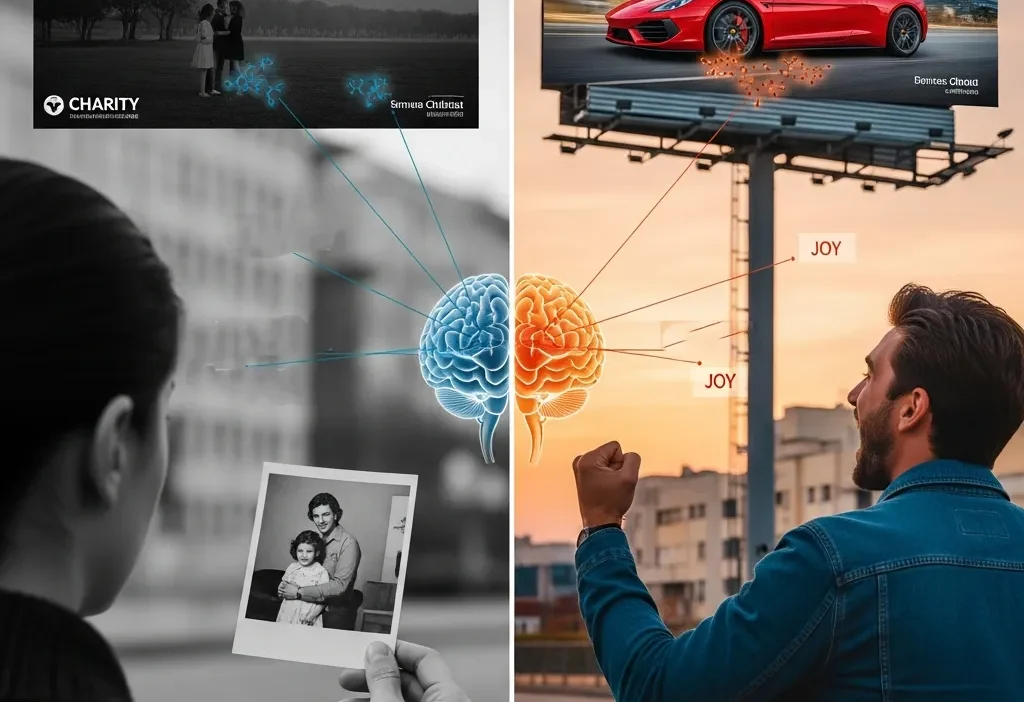
Emotional advertising psychology is the practice of using human emotions—fear, joy, trust, and more—to influence purchasing decisions. Brands that master psychological triggers in ads consistently outperform competitors in recall, engagement, and long-term loyalty. This post breaks down the science, techniques, and strategies you need to make it work.
Ads that make you cry sell more than ads that make you think. That might sound counterintuitive, but decades of consumer psychology research back it up. Harvard Business School professor Gerald Zaltman found that approximately 95% of purchasing decisions are made subconsciously—driven by emotion far more than logic. Emotional advertising psychology sits at the intersection of neuroscience, behavioral economics, and creative storytelling, and it’s one of the most powerful tools a modern marketer can wield.
So what exactly is emotional advertising psychology? At its core, it’s the strategic use of emotional triggers within advertising to shape consumer perception, drive behavior, and build lasting brand relationships. Rather than simply listing product features, emotionally driven ads connect with audiences on a human level—making them feel something before they ever open their wallets.
For modern brands competing in crowded digital spaces, this approach is no longer optional. Consumers are exposed to thousands of ads daily, and the vast majority are forgotten within seconds. The ones that stick? They make people feel something real. Whether that’s nostalgia, excitement, trust, or even a twinge of fear, emotional resonance is what separates forgettable content from campaigns that define brands for years.
This post is a comprehensive guide to emotional advertising psychology—from the core science behind it to the specific psychological triggers in ads, practical advertising psychology techniques, real-world case studies, and a step-by-step framework for integrating emotion into your paid advertising strategy guide.
Understanding the Core of Emotional Advertising Psychology
What are the key principles of emotional advertising psychology?
Emotional advertising psychology is grounded in the idea that emotions are not a distraction from rational decision-making—they are integral to it. Neuroscientist Antonio Damasio’s research on patients with damage to the emotion-processing regions of the brain revealed a striking finding: without the ability to feel emotions, these individuals couldn’t make even simple decisions. Emotion, it turns out, is the engine that drives choice.
Several key principles underpin emotional advertising psychology:
- Affect heuristic: People rely on their current emotional state as a mental shortcut when making decisions. Positive emotions lead to more favorable evaluations of products and brands.
- Emotional memory encoding: Events or messages tied to strong emotions are stored more deeply in long-term memory. Ads that evoke emotion are remembered longer.
- Mood congruence: Consumers in a positive mood are more receptive to persuasive messaging. Brands that create positive emotional experiences benefit from this effect during purchase moments.
How do emotions influence consumer behavior?
Emotional advertising psychology works because the limbic system—the brain’s emotional processing center—responds to stimuli before the rational prefrontal cortex has a chance to evaluate it. By the time a consumer consciously processes an ad, an emotional response has already been registered. This primes the consumer’s attitude toward the brand before logic even enters the picture.
According to a study by the Institute of Practitioners in Advertising (IPA), campaigns with purely emotional content perform twice as well as those with only rational content, and emotional campaigns outperform rational campaigns in terms of profit generation by a ratio of nearly 2:1.
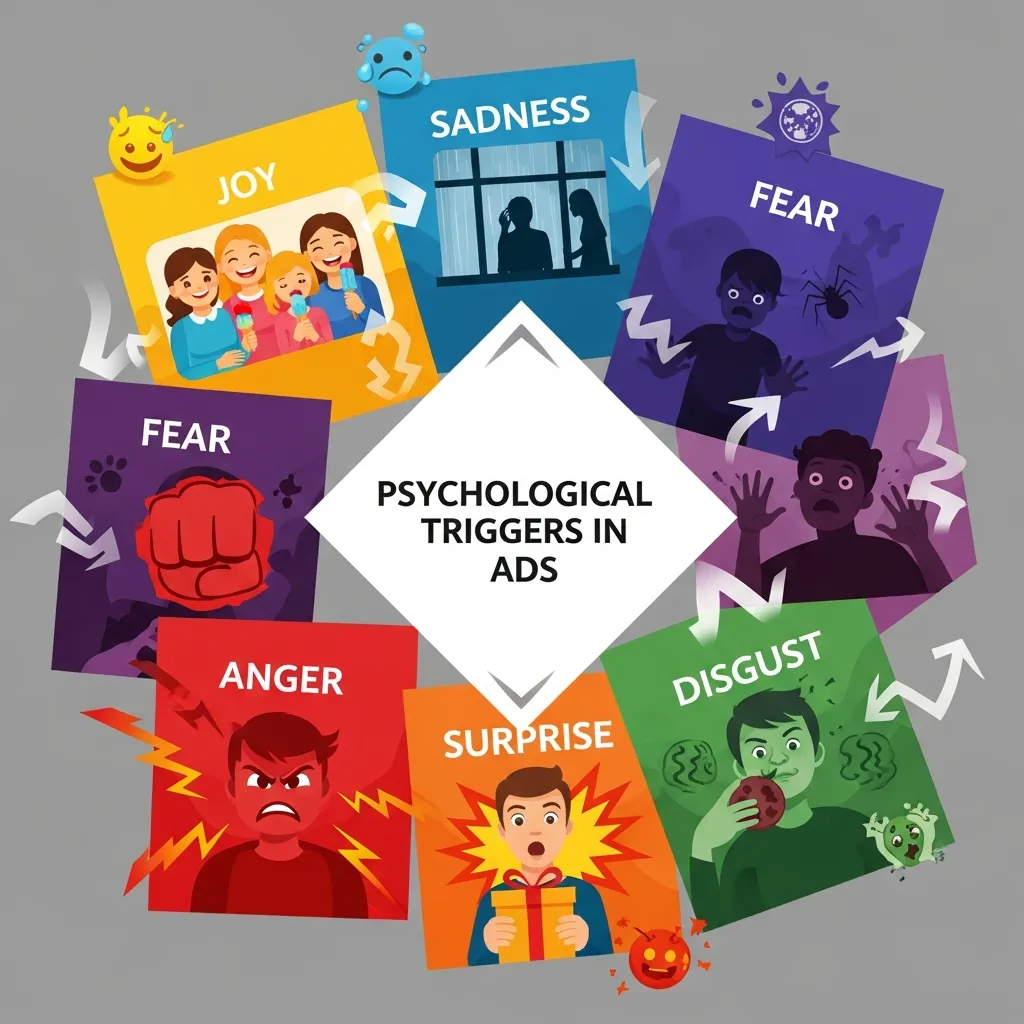
Psychological Triggers in Ads: The Six Core Emotions
How does fear work as a psychological trigger in advertising?
Fear is one of the most powerful psychological triggers in ads. It activates the brain’s threat-response system, compelling immediate attention and action. Insurance companies, health brands, and cybersecurity firms use fear-based messaging to highlight potential loss—what happens if you don’t act. The key is specificity: vague fear paralyzes, while targeted fear motivates. Pairing fear with a clear, actionable solution converts anxiety into purchase behavior.
Why do joy and happiness make ads more effective?
Positive emotional states increase openness, generosity, and brand affinity. Coca-Cola’s “Share a Coke” campaign and Apple’s early iPod ads are textbook examples of joy-based emotional advertising psychology. Associating a product with happiness, connection, or celebration creates a pavlovian link in the consumer’s mind—seeing the brand triggers the emotion, even without an ad present.
When is sadness an effective tool in advertising?
Sadness evokes empathy, and empathy drives connection. Charitable organizations, healthcare brands, and social cause campaigns frequently use sadness to motivate prosocial behavior. The critical balance: sadness should lead the viewer toward hope or resolution, not leave them in despair. Ads that move people to tears—without offering a path forward—can generate discomfort rather than affinity.
How does anger drive consumer action?
Anger is a high-activation emotion that mobilizes people to act. Brands that tap into shared frustrations—slow internet, unfair pricing, environmental destruction—can channel that energy toward a product or cause. Dollar Shave Club’s launch video used mild anger at overpriced razors to fuel a viral campaign. Emotional advertising psychology that leverages anger must feel authentic and aligned with real consumer grievances.
What role does surprise play in memorable advertising?
Surprise captures attention instantly by violating expectations. The brain’s attention network responds sharply to unexpected stimuli, which is why surprising ads generate higher recall. Old Spice’s “The Man Your Man Could Smell Like” campaign worked precisely because it defied every expectation for a men’s deodorant ad. Surprise paired with humor amplifies the effect, creating ads people share.
How does trust function as an emotional trigger in paid advertising?
Trust is a slower-burning emotion, but it’s foundational to long-term brand loyalty. Psychological triggers in ads designed to build trust include consistency, social proof, transparency, and expert endorsement. Trust-based emotional advertising psychology is particularly effective in industries like finance, healthcare, and B2B software, where risk aversion is high and relationships matter more than impulse.
Advertising Psychology Techniques for High-Impact Campaigns
How does storytelling enhance emotional advertising psychology?
Storytelling is the most effective delivery mechanism for emotional advertising psychology. A well-crafted narrative triggers neural coupling—the brain of the listener begins to synchronize with the storyteller’s brain, creating a genuine feeling of shared experience. Ads structured as stories (with a protagonist, conflict, and resolution) outperform product-feature ads in emotional engagement and brand recall.
Advertising psychology techniques rooted in storytelling include the hero’s journey (where the consumer is the hero and the brand is the guide), transformation narratives, and “day in the life” formats that mirror the audience’s own experiences.
What is the role of music and visuals in emotional advertising?
Music is one of the fastest pathways to emotional response. Studies show that background music in ads influences mood, brand perception, and purchase intent—even when consumers aren’t consciously aware of it. Major vs. minor keys, tempo, and familiar melodies all carry distinct emotional associations.
Visually, human faces—especially expressive ones—activate mirror neurons that prompt the viewer to feel the depicted emotion. Close-ups of genuine emotion in advertising outperform product close-ups in engagement metrics.
How does color psychology support emotional advertising?
Color psychology is a well-established component of advertising psychology techniques. Different hues trigger predictable emotional associations:
- Red: urgency, passion, energy (used heavily in sales and food marketing)
- Blue: trust, calm, reliability (dominant in finance and healthcare)
- Yellow: optimism, warmth, attention (used in retail and consumer goods)
- Green: health, nature, sustainability (common in wellness and eco brands)
- Black: luxury, sophistication, authority (prevalent in premium branding)
Emotional advertising psychology practitioners align color choices with the target emotion of the campaign—not just brand guidelines.
Why does personalization strengthen emotional connection in ads?
Personalization signals recognition. When an ad references a consumer’s behavior, location, name, or preference, it triggers a sense of being understood—a deeply positive emotional experience. This is why personalized email subject lines consistently outperform generic ones, and why dynamic ad creative (which adapts based on user data) generates stronger emotional advertising psychology outcomes than static campaigns.
How do scarcity and urgency leverage emotional advertising psychology?
Scarcity taps into loss aversion—one of the most reliable psychological triggers in ads. The fear of missing out (FOMO) compels action far more effectively than the promise of gain. Countdown timers, limited stock notifications, and “only 3 left” messaging create urgency that cuts through hesitation. When used ethically and truthfully, scarcity is a potent advertising psychology technique.
What makes social proof effective in emotional advertising?
Social proof works through the emotional experience of belonging and validation. Testimonials, user-generated content, star ratings, and influencer endorsements reduce purchase anxiety by signaling that others have already made—and benefited from—this decision. Emotional advertising psychology that incorporates social proof taps into both trust and the human desire for social conformity.
How Emotional Advertising Builds Brand Loyalty and Recognition

How does emotional advertising create memorable brand experiences?
Memory formation is deeply tied to emotional arousal. The amygdala, which processes emotions, also regulates memory consolidation—meaning emotionally charged experiences are encoded more vividly and durably. Brands that consistently deliver emotionally resonant advertising build stronger memory structures around their products, making them more likely to surface in the consumer’s mind at the moment of purchase.
How does emotional advertising foster long-term consumer-brand relationships?
Emotional advertising builds brand loyalty by creating what psychologists call “emotional brand attachment”—a psychological bond between the consumer and the brand that transcends functional value. This attachment is built through repeated positive emotional experiences, consistent brand values, and campaigns that make consumers feel seen and understood.
Research published in the Journal of Consumer Psychology found that emotional brand attachment predicts both purchase frequency and advocacy behavior—meaning emotionally attached consumers buy more often and recommend more actively.
How does emotional branding differentiate brands from competitors?
Products can be replicated. Emotions are harder to copy. Two airlines can offer the same routes and pricing; the one that makes you feel respected and valued will win your loyalty. Emotional advertising psychology gives brands a defensible differentiation strategy—one that competitors cannot simply undercut with a price reduction.
Implementing Emotional Advertising Psychology in Your Paid Advertising Strategy Guide
How do you identify your target audience’s emotional landscape?
The first step in any emotional paid advertising strategy guide is audience research—not just demographic data, but psychographic and emotional profiling. Tools like social listening platforms, customer interviews, and sentiment analysis reveal the emotional triggers, anxieties, and aspirations of your audience. Build emotional personas alongside traditional buyer personas.
How do you craft emotionally resonant ad copy and visuals?
Lead with the emotion, not the product. Before writing a single headline, define the feeling you want the audience to leave with. Every creative choice—word selection, imagery, pacing, color—should serve that emotional goal. Use the second person (“you”) to create immediacy, and anchor your messaging in relatable human experiences rather than abstract product attributes.
Why is A/B testing essential for emotional advertising campaigns?
Emotional responses are not universal. What evokes nostalgia in one demographic may feel irrelevant to another. A/B testing different emotional appeals—running fear-based copy against hope-based copy, for example—generates data on which emotional triggers in ads resonate most with your specific audience. Test one emotional variable at a time for clean, interpretable results.
How do you measure the impact of emotional advertising psychology campaigns?
Traditional metrics (CTR, conversions, ROAS) capture behavioral outcomes but miss emotional impact. Supplement these with:
- Brand lift studies: Measure shifts in brand perception and emotional association
- Sentiment analysis: Track audience emotional response to ad creative in comments and social mentions
- Facial coding and biometric testing: Advanced tools used by large brands to measure real-time emotional responses to ads
- Net Promoter Score (NPS): A proxy for emotional brand attachment and advocacy likelihood
What are the ethical considerations in emotional advertising psychology?
Emotional advertising psychology is powerful—which means it carries ethical responsibility. Manipulation differs from persuasion: ethical emotional advertising connects honestly with real consumer emotions, while manipulative advertising exploits vulnerabilities or creates false urgency. Advertisers must be especially cautious when targeting emotional triggers like fear or sadness toward vulnerable populations, including children, people with mental health challenges, or those in financial distress.
Case Studies: Brands Excelling in Emotional Advertising
How did Nike use emotional advertising psychology to build a global brand?
Nike’s “Just Do It” campaigns are textbook emotional advertising psychology. Rather than advertising shoe specifications, Nike consistently tells stories of human perseverance, self-doubt overcome, and identity transformation. The brand positions itself not as a product but as a participant in the consumer’s emotional journey. The “Dream Crazy” campaign featuring Colin Kaepernick deliberately invoked strong emotions—including controversy—to deepen connection with Nike’s core audience. Following its release, Nike reported a 31% increase in sales.
How did Always use emotional advertising to transform brand perception?
Always’ “Like a Girl” campaign is one of the most cited examples of emotional advertising psychology in modern marketing. Launched in 2014, the campaign addressed the emotional pain point of gender-based self-esteem, turning a culturally dismissive phrase into a source of empowerment. The campaign won multiple Cannes Lions awards and generated over 90 million views—demonstrating how emotional advertising techniques rooted in social justice can drive extraordinary reach and brand affinity.
What lessons do successful emotional advertising campaigns teach?
The through-line across successful emotional advertising campaigns is authenticity. Emotional advertising psychology fails when the emotion feels manufactured or disconnected from the brand’s actual values and behavior. The most effective campaigns tell true stories about real human experiences—and align those stories with what the brand genuinely stands for.
The Future of Emotional Advertising Psychology
How is AI transforming emotional advertising psychology?
AI and machine learning are enabling emotional advertising psychology at a scale previously impossible. Sentiment analysis tools can process millions of social data points to map audience emotional states in real time. Generative AI platforms produce emotionally varied creative at speed, enabling rapid testing of different emotional appeals across segments. Emotion-recognition technology—using facial coding via webcam—allows brands to measure emotional responses to ads without expensive lab settings.
How is the consumer emotional landscape evolving?
Post-pandemic consumer psychology has shifted. According to Edelman’s Trust Barometer (2023), trust in institutions has declined globally, while trust in “people like me” has increased. This means peer-based emotional advertising psychology—user-generated content, authentic testimonials, community-driven campaigns—is gaining ground over polished top-down brand messaging. Consumers are also increasingly attuned to performative emotion; brands that claim values they don’t practice face swift backlash.
How do brands maintain authenticity in emotionally driven advertising?
Authenticity in emotional advertising psychology is not an aesthetic choice—it’s a strategic imperative. Consumers, particularly Millennials and Gen Z, are highly skilled at detecting emotional manipulation. Brands that maintain authenticity do so through consistency (the same values expressed across every touchpoint), transparency (honest communication about products and practices), and specificity (emotional stories grounded in real details, not vague inspiration).
Make Emotion Your Competitive Advantage
Emotional advertising psychology is not a soft, feel-good addition to a marketing strategy—it’s the backbone of the world’s most effective advertising. The science is clear: emotions drive decisions, emotions build memory, and emotions build loyalty. Brands that invest in understanding and applying psychological triggers in ads, mastering advertising psychology techniques, and building their paid advertising strategy guide around emotional resonance will consistently outperform those that don’t.
The starting point is simple: know your audience’s emotional landscape. From there, every creative and strategic decision—story structure, color palette, music, personalization, social proof—can be aligned toward a specific emotional goal. Test, measure, iterate.
The brands that win hearts don’t just sell products. They make people feel something worth remembering.
Frequently Asked Questions
What is emotional advertising psychology?
Emotional advertising psychology is the strategic use of human emotions—such as fear, joy, trust, sadness, anger, and surprise—within advertising to influence consumer perception, shape purchasing behavior, and build long-term brand loyalty. It draws on neuroscience, behavioral psychology, and consumer research to design campaigns that connect with audiences on a deeper than rational level.
How do psychological triggers in ads work?
Psychological triggers in ads activate specific emotional responses in the viewer’s brain before conscious reasoning takes place. The brain’s limbic system processes emotional stimuli rapidly, priming the consumer’s attitude toward the brand. Common triggers include fear of loss, social belonging, desire for identity expression, and the need for trust and security.
What are the most effective advertising psychology techniques?
The most effective advertising psychology techniques include storytelling, color psychology, social proof, scarcity and urgency messaging, music and visual emotional cues, and personalization. Each technique targets specific emotional states and is most effective when aligned with both the audience’s emotional landscape and the brand’s core values.
How does emotional advertising build brand loyalty?
Emotional advertising builds brand loyalty by creating emotional brand attachment—a psychological bond that transcends product functionality. Repeated positive emotional experiences with a brand’s advertising increase purchase frequency and advocacy behavior, according to research in the Journal of Consumer Psychology. Loyalty built on emotion is more durable than loyalty built on price or convenience.
Can emotional advertising psychology be applied to a paid advertising strategy guide?
Yes. Emotional advertising psychology is directly applicable to paid media. In a paid advertising strategy guide, emotional principles inform audience segmentation (targeting by emotional profile, not just demographics), creative development (leading with emotion, not features), A/B testing (comparing emotional appeals), and measurement (using brand lift and sentiment analysis alongside conversion metrics).
What are the ethical considerations of emotional advertising?
Ethical emotional advertising connects honestly with genuine consumer emotions without exploiting vulnerabilities. Manipulative tactics—false urgency, fear-mongering, targeting vulnerable populations—cross ethical lines. Brands should ensure that emotional claims are truthful, that urgency signals reflect real conditions, and that emotionally sensitive content is handled responsibly.
How do I identify the right emotions to target in my advertising?
Identify target emotions through psychographic research: customer interviews, social listening, sentiment analysis, and emotional persona mapping. Align the chosen emotion with both the audience’s core anxieties and aspirations, and the brand’s authentic values. Avoid forcing an emotional angle that doesn’t fit the product category or brand story.
What is the role of storytelling in emotional advertising psychology?
Storytelling is the primary delivery mechanism for emotional advertising psychology. Narrative structure triggers neural coupling between the storyteller and the audience, creating a genuine shared emotional experience. The most effective advertising stories position the consumer—not the brand—as the hero, with the brand playing the role of guide or enabler in the consumer’s transformation.
How can I measure the success of emotional advertising campaigns?
Measure emotional advertising success through a combination of behavioral metrics (conversion rate, ROAS, purchase frequency) and emotional metrics (brand lift studies, sentiment analysis, NPS, and social engagement quality). Advanced measurement includes biometric testing and facial coding to capture real-time emotional responses to creative.
What are common mistakes to avoid in emotional advertising?
Common mistakes include: choosing emotions that don’t align with the brand’s actual values (creating inauthenticity), using manipulative tactics like false scarcity, producing emotionally generic content that doesn’t connect with the specific audience, failing to test different emotional appeals across audience segments, and ignoring the ethical dimensions of emotionally sensitive messaging.