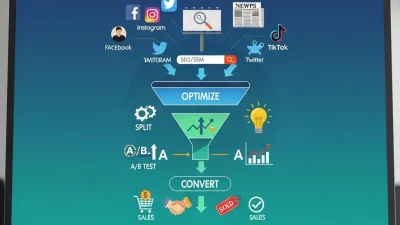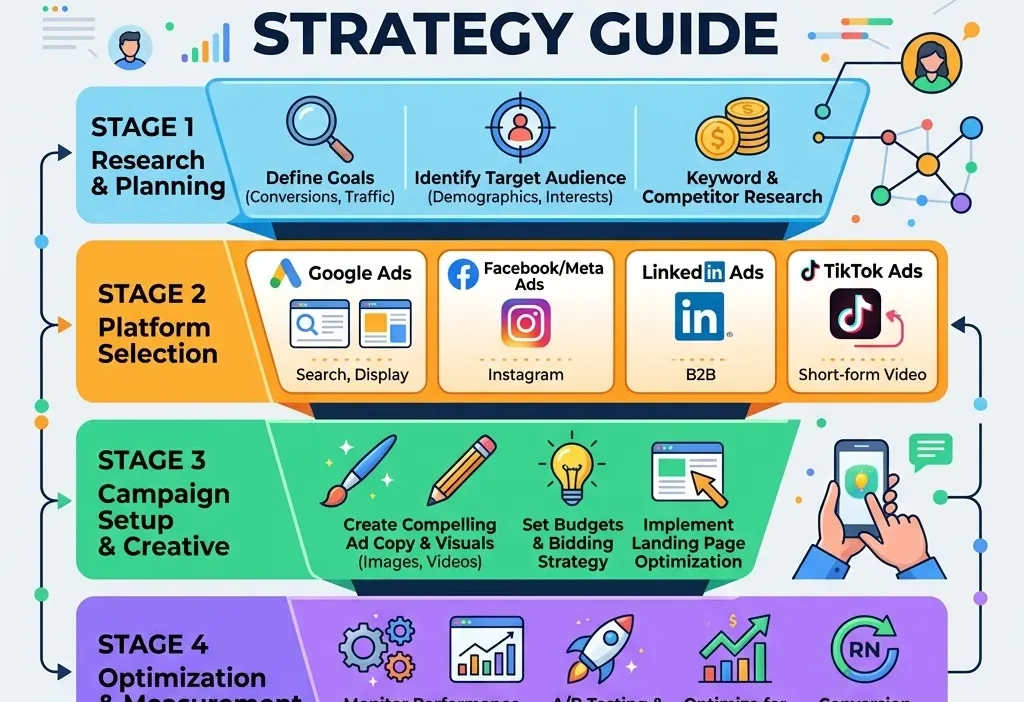
A successful paid advertising strategy combines precise audience targeting, smart platform selection, compelling ad copywriting, and continuous performance optimization. Businesses that align their paid advertising strategy with clear KPIs, structured A/B testing, and data-driven bid management consistently achieve stronger Ad Conversion Rates and higher ROI across digital marketing channels.
Paid advertising has become one of the most powerful levers in digital marketing. When executed well, a paid advertising strategy can drive immediate traffic, generate qualified leads, and produce measurable revenue—often within days of launch. When executed poorly, it can drain budgets with very little to show for it.
The difference between those two outcomes rarely comes down to budget size. It comes down to strategy.
This guide walks you through every stage of building, executing, and refining a paid advertising strategy—from foundational planning to advanced optimization techniques. Whether you’re running Google Ads, Facebook campaigns, or exploring programmatic placements, the principles here apply. By the end, you’ll have a clear roadmap for improving your Ad Conversion Rate, leveraging Conversion Rate Optimization Ads, and sustaining growth in an increasingly competitive digital landscape.
What Are the Foundations of a Strong Paid Advertising Strategy?
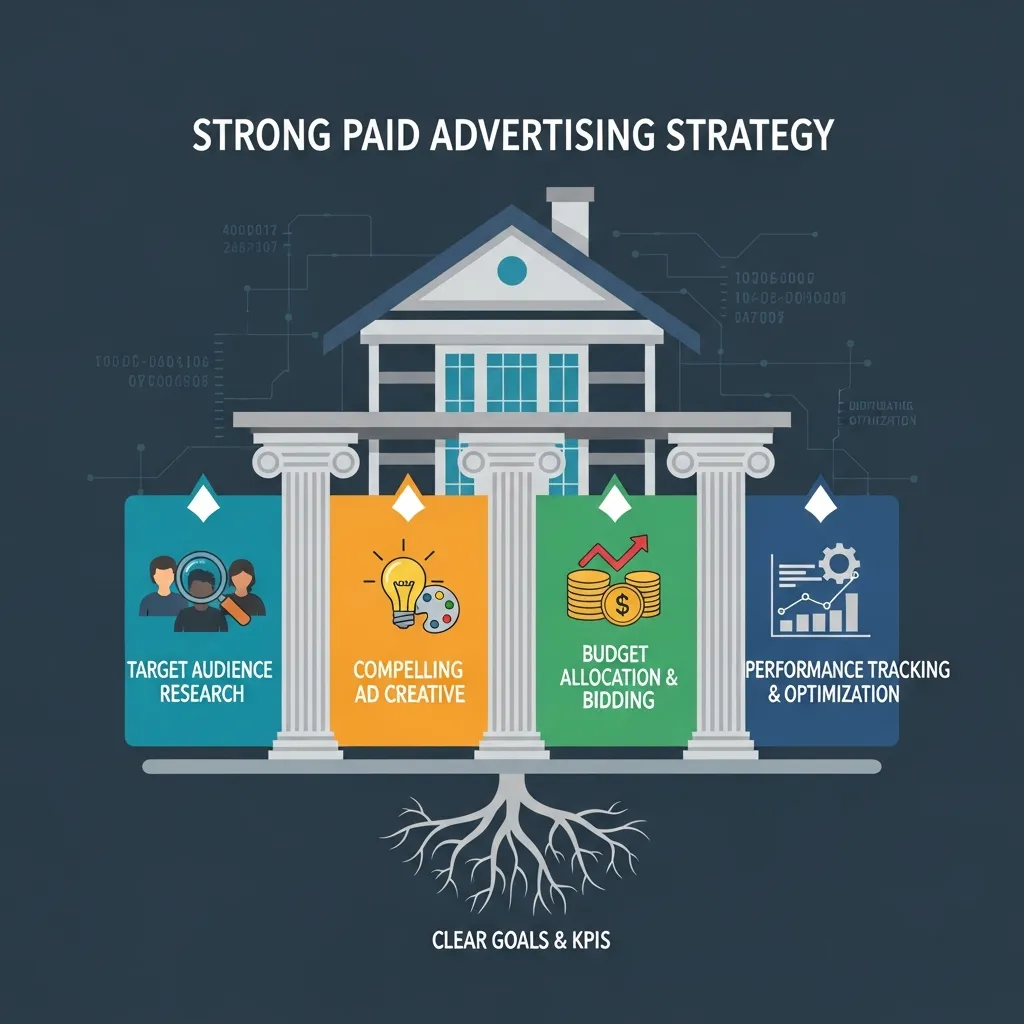
How do you define your target audience for paid ads?
Every effective paid advertising strategy begins with a precise understanding of who you’re trying to reach. Demographics are a starting point—age, gender, location, income—but the most effective audience definitions go deeper. Psychographic data (interests, values, purchase intent) and behavioral signals (past website visits, app activity, purchase history) allow advertisers to build audiences that actually convert.
Tools like Google Audience Manager, Meta’s Audience Insights, and third-party data platforms make this process more accessible. The goal is specificity: a narrower, better-defined audience typically produces a higher Ad Conversion Rate than a broad, generalized one.
What KPIs and goals should guide a paid advertising strategy?
Setting clear, measurable goals is non-negotiable. Common KPIs in paid advertising include:
- Return on Ad Spend (ROAS): Revenue generated per dollar spent on ads
- Cost Per Acquisition (CPA): Total ad spend divided by number of conversions
- Click-Through Rate (CTR): Percentage of users who click an ad after seeing it
- Ad Conversion Rate: The percentage of users who complete a desired action after clicking
Each campaign type warrants different KPIs. A brand awareness campaign might prioritize impressions and reach; a lead generation campaign should focus on CPA and conversion volume. Aligning KPIs to business objectives keeps campaigns focused and easier to optimize.
How should you allocate budget across a paid advertising strategy?
Budget allocation depends on campaign stage, channel performance, and business goals. A commonly used framework is the 70-20-10 rule: 70% of budget goes to proven, high-performing channels; 20% to emerging or experimental placements; and 10% to testing entirely new approaches.
Start conservatively, gather data, and scale what works. Avoid spreading budget too thin across too many platforms simultaneously—especially in the early stages of a paid advertising strategy.
What Are the Key Components of a Successful Paid Advertising Strategy?
Which platforms should you include in your paid advertising strategy?
Platform selection should match where your audience spends time and what stage of the funnel you’re targeting.
- Google Ads (Search, Display, Shopping): Best for capturing high-intent demand. Search ads reach users actively looking for your product or service, making them highly efficient for conversion-focused campaigns.
- Facebook and Instagram Ads: Strong for audience-based targeting, retargeting, and visual storytelling. Facebook ad campaigns offer some of the most granular demographic and interest targeting available in digital marketing.
- LinkedIn Ads: Ideal for B2B audiences, particularly for targeting by job title, company size, or industry.
- TikTok Ads: Growing rapidly among younger audiences; effective for top-of-funnel awareness with short-form video.
- Programmatic and Native Ads: Useful for scaling reach across thousands of publisher sites while maintaining audience targeting precision.
What does effective Google Ads Copywriting look like?
Google Ads Copywriting is both a science and an art. Each ad must communicate value within strict character limits—headlines cap at 30 characters, descriptions at 90. The most effective Google Ads Copywriting typically includes:
- A primary keyword in the first headline
- A clear, specific value proposition (e.g., “Free 14-Day Trial” beats “Try Our Platform”)
- A direct call to action that matches the landing page (e.g., “Get a Free Quote” aligns with a quote form page)
- Ad extensions—sitelinks, callouts, structured snippets—to increase real estate and relevance
Responsive Search Ads (RSAs) now dominate Google’s ad formats, requiring multiple headline and description variations that Google’s algorithm tests automatically. Writing at least 8–10 diverse headlines gives the algorithm enough material to find high-performing combinations.
How does Facebook Ad Copywriting differ from other formats?
Facebook Ad Copywriting operates differently from Google’s search format. On Facebook and Instagram, users aren’t actively searching—they’re scrolling. The copy must interrupt without feeling intrusive.
Effective Facebook Ad Copywriting typically leads with the reader’s problem or aspiration, follows with a concise proof point or offer, and closes with a frictionless call to action. Short-form copy (under 125 characters for the primary text) tends to outperform long paragraphs, especially on mobile. That said, for high-consideration purchases, longer-form copy with a storytelling structure can build enough trust to drive conversions.
Visual creative and copy must work together. A mismatched image and headline will hurt performance regardless of how well each element performs in isolation.
How Do You Optimize Ad Conversion Rate and Leverage Conversion Rate Optimization Ads?
What is Ad Conversion Rate and why does it matter?
Ad Conversion Rate measures the percentage of users who take a desired action—purchase, sign-up, download—after clicking an ad. It’s one of the most important metrics in any paid advertising strategy because it directly links ad spend to business outcomes.
Industry benchmarks vary widely. According to WordStream, the average Ad Conversion Rate across all industries on Google Ads Search campaigns is approximately 3.75%. On display networks, it drops to around 0.77%. Knowing your baseline allows you to measure improvement objectively.
What are Conversion Rate Optimization Ads, and how do they differ from standard ads?
Conversion Rate Optimization Ads are specifically designed and tested to maximize the percentage of clicks that convert—not just to drive traffic. Standard ads may optimize for clicks or impressions; Conversion Rate Optimization Ads focus on post-click behavior, landing page alignment, and user intent matching.
This approach typically involves:
- Landing page cohesion: Ensuring the message on the ad matches the headline and offer on the landing page
- Friction reduction: Minimizing form fields, load times, and steps between click and conversion
- Trust signals: Including reviews, badges, and guarantees near CTAs
- A/B testing: Systematically testing one variable at a time—headline, CTA button color, hero image—to identify what drives conversions
What A/B testing strategies improve paid advertising performance?
Effective A/B testing in a paid advertising strategy requires structure. Test one variable at a time, run tests long enough to reach statistical significance (typically 100–500 conversions per variant), and document results systematically.
High-impact variables to test include: ad headline, call to action, offer type (discount vs. free trial), image vs. video creative, and landing page layout. Platforms like Google Optimize, Unbounce, and VWO make landing page testing accessible without developer resources.
What Advanced Tactics Can Elevate a Paid Advertising Strategy?

How do retargeting and audience segmentation improve campaign performance?
Retargeting is one of the highest-ROI tactics available in paid advertising. Users who have already visited your website, watched your video, or engaged with your social content are significantly more likely to convert than cold audiences. According to Criteo, retargeted users are 70% more likely to convert than those who haven’t been exposed to your brand.
Segmenting retargeting audiences by behavior adds another performance layer. Someone who viewed a pricing page should see a different ad than someone who only visited the homepage. Tailoring the message to where someone is in the funnel—awareness, consideration, decision—makes Conversion Rate Optimization Ads far more effective.
How do dynamic ads and CRM integration improve a paid advertising strategy?
Dynamic ads automatically populate ad content based on user data—browsing history, location, or CRM attributes. Google’s Dynamic Search Ads generate headlines based on a user’s query and your website content, reducing manual workload while maintaining relevance. Meta’s Dynamic Ads serve personalized product images to users based on their browsing behavior, making them particularly effective for e-commerce.
Connecting your CRM to ad platforms allows for customer match targeting, lookalike audience creation, and suppression of existing customers from acquisition campaigns—all of which improve efficiency across a paid advertising strategy.
How Do You Measure Success in a Paid Advertising Strategy?
What metrics and tracking tools should every paid advertiser use?
No paid advertising strategy is complete without robust tracking. The essential setup includes:
- Google Analytics 4 (GA4): Track user behavior post-click, set up conversion goals, and attribute revenue to specific campaigns
- Meta Pixel: Capture Facebook and Instagram conversions, build Custom Audiences, and enable Conversion Rate Optimization Ads
- UTM Parameters: Tag every ad URL to track performance by source, medium, campaign, and ad group
- Platform-native reporting: Google Ads, Meta Ads Manager, and LinkedIn Campaign Manager all offer conversion tracking that feeds back into bid optimization algorithms
Beyond setup, the key is interpreting data to make decisions—not just reporting on it. Rising CPA with stable CTR suggests a landing page problem. Declining CTR with stable CPA suggests ad creative fatigue.
What Challenges Should You Prepare for in Paid Advertising?
How do Ad Blocker Extensions affect paid advertising campaigns?
Ad Blocker Extension usage has grown steadily, with GlobalWebIndex estimating that over 40% of internet users globally use some form of ad blocking. This primarily affects display and programmatic campaigns rather than native search ads, but it’s a real consideration in any paid advertising strategy.
Mitigating the impact involves diversifying channel mix, investing in native ad formats that bypass Ad Blocker Extension filters, and prioritizing platforms like Google Search where Ad Blocker Extension tools have less effect. First-party data strategies—email marketing, SMS, loyalty programs—provide further resilience against ad blocking trends.
How do platform algorithm changes affect a paid advertising strategy?
Ad platforms update their algorithms, targeting options, and bidding systems frequently. Meta’s advertising ecosystem changed significantly following Apple’s iOS 14.5 update in 2021, which restricted tracking and reduced the effectiveness of pixel-based targeting. Advertisers who relied heavily on granular retargeting saw performance drops overnight.
The lesson: avoid over-dependence on any single platform or tactic. A diversified paid advertising strategy across multiple channels, combined with strong first-party data collection, provides a buffer against platform-specific disruptions.
What Trends Are Shaping the Future of Paid Advertising?
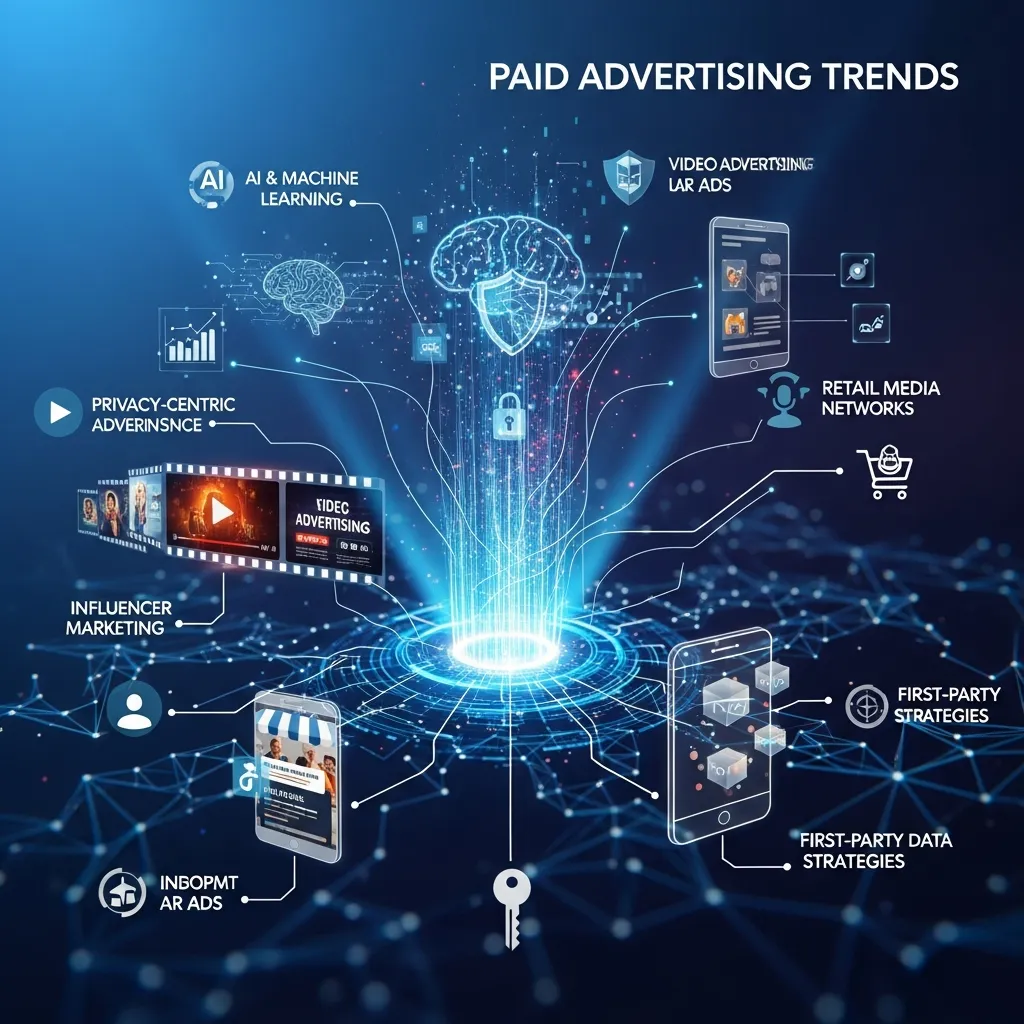
AI and machine learning are already embedded in every major ad platform. Google’s Performance Max, Meta’s Advantage+ campaigns, and smart bidding algorithms are reducing the need for manual optimization while raising the floor on campaign performance. Advertisers who understand how to feed these systems—with clean conversion data, diverse creative, and clear goal parameters—will extract the most value.
Privacy regulations including GDPR, CCPA, and the deprecation of third-party cookies are reshaping digital marketing targeting. First-party data collection, contextual targeting, and privacy-safe audience modeling are becoming competitive advantages. Brands that invest in CRM and data infrastructure now will maintain targeting capability as restrictions tighten.
Voice search advertising remains nascent but growing. As smart speaker usage and voice-based queries increase, paid advertising strategies will need to account for conversational query formats—particularly in local search.
Building a Paid Advertising Strategy That Compounds Over Time
A paid advertising strategy is never finished. It’s a system that improves through iteration—better data, better creative, better audience insights, and better alignment between what ads promise and what landing pages deliver.
The fundamentals remain constant: know your audience, set measurable goals, craft compelling ad copy (whether that’s Google Ads Copywriting or Facebook Ad Copywriting), test systematically, and track everything. Layer in advanced tactics like Conversion Rate Optimization Ads, retargeting, and dynamic creative as your data matures.
The businesses that win in paid advertising long-term aren’t necessarily those with the biggest budgets. They’re the ones who treat every campaign as a learning opportunity, refine their approach based on evidence, and adapt quickly when platforms and behaviors shift.
Start with clarity of purpose. Build with discipline. Optimize relentlessly.
Frequently Asked Questions About Paid Advertising Strategy
What is a good Ad Conversion Rate for paid search campaigns?
The average Ad Conversion Rate for Google Ads Search campaigns across all industries is approximately 3.75%, according to WordStream. However, “good” depends on your industry—legal services average around 6.98%, while e-commerce typically falls between 1.5% and 3%. Compare against your historical baseline and industry benchmarks, not just the overall average.
How do Conversion Rate Optimization Ads differ from standard paid ads?
Standard paid ads are designed to maximize clicks or impressions. Conversion Rate Optimization Ads are specifically structured to maximize the percentage of clicks that convert into leads, sales, or sign-ups. This involves aligning the ad message with the landing page offer, reducing post-click friction, and running continuous A/B tests on copy, creative, and landing page elements.
What are the best practices for Google Ads Copywriting?
Effective Google Ads Copywriting includes placing the target keyword in the first headline, writing a specific and benefit-driven value proposition, matching the CTA to the landing page action, and using all available ad extensions to increase visibility. For Responsive Search Ads, writing at least 8–10 diverse headlines gives Google’s algorithm the best material to optimize combinations automatically.
How does Facebook Ad Copywriting impact campaign performance?
Facebook Ad Copywriting directly affects CTR, relevance scores, and ultimately Ad Conversion Rate. Strong Facebook Ad Copywriting opens with the reader’s problem or desire, builds brief credibility, and delivers a clear, low-friction call to action. Because Facebook users aren’t in a buying mindset (unlike search users), copy must earn attention quickly—usually within the first one to two lines before the “See More” cutoff.
How should I allocate budget across platforms in a paid advertising strategy?
Start by identifying where your target audience is most active and what stage of the funnel you’re targeting. A 70-20-10 allocation model works well: 70% to proven high-performing channels, 20% to channels showing growth potential, and 10% to testing new formats or platforms. Avoid spreading budget across too many channels simultaneously before you have performance data to guide decisions.
How does an Ad Blocker Extension affect my campaigns, and what can I do about it?
Ad Blocker Extension tools primarily reduce the reach of display and programmatic campaigns, with less impact on native search ads. To minimize this effect, diversify your channel mix, invest in native ad formats that aren’t blocked, and strengthen first-party data channels like email and SMS. Over 40% of global users employ some form of ad blocking, making channel diversification a strategic necessity.
What is ROAS and how should it guide my paid advertising strategy?
Return on Ad Spend (ROAS) measures how much revenue is generated for every dollar spent on advertising. A ROAS of 4 means you earned $4 for every $1 spent. ROAS should guide budget allocation—channels and campaigns with higher ROAS warrant more investment. However, ROAS alone doesn’t account for margin, so combining it with CPA and Customer Lifetime Value gives a more complete picture.
How often should I run A/B tests within a paid advertising strategy?
A/B testing should be continuous, not occasional. Run at least one test per campaign at all times, rotating through high-impact variables: ad headline, CTA, creative format, offer type, and landing page layout. Ensure each test runs long enough to achieve statistical significance—typically a minimum of 100 conversions per variant—before drawing conclusions.
What role does audience segmentation play in improving Ad Conversion Rate?
Audience segmentation allows you to deliver tailored messages to users based on where they are in the buying journey. Someone who visited a pricing page should see a different ad—with a stronger conversion offer—than someone who only visited the homepage. Segmented retargeting audiences consistently outperform broad audiences, producing higher Ad Conversion Rates at lower CPAs.
How do AI-powered features in platforms like Google and Meta affect a paid advertising strategy?
AI features like Google’s Performance Max and Meta’s Advantage+ campaigns automate audience targeting, bidding, and creative selection. They perform best when fed high-quality conversion data, diverse creative assets, and clear campaign goals. Advertisers who understand how to structure campaigns for these AI systems—rather than fighting against them—typically see stronger performance with lower manual management overhead.
How do privacy regulations like GDPR and iOS changes impact paid advertising?
Privacy regulations and tracking restrictions have reduced the availability of third-party data used for ad targeting and conversion attribution. This makes first-party data—email lists, CRM data, website behavior tracked via server-side tools—increasingly valuable. Building direct data collection systems is now a core part of any long-term paid advertising strategy in digital marketing.
When should a business scale up its paid advertising budget?
Scale budget when campaigns demonstrate consistent, profitable performance across a meaningful data sample—typically at least 50–100 conversions per campaign. Scaling prematurely, before conversion data is statistically reliable, risks amplifying losses rather than profits. Increase budgets incrementally (15–25% at a time) to avoid disrupting platform algorithms that have already optimized to current spend levels.