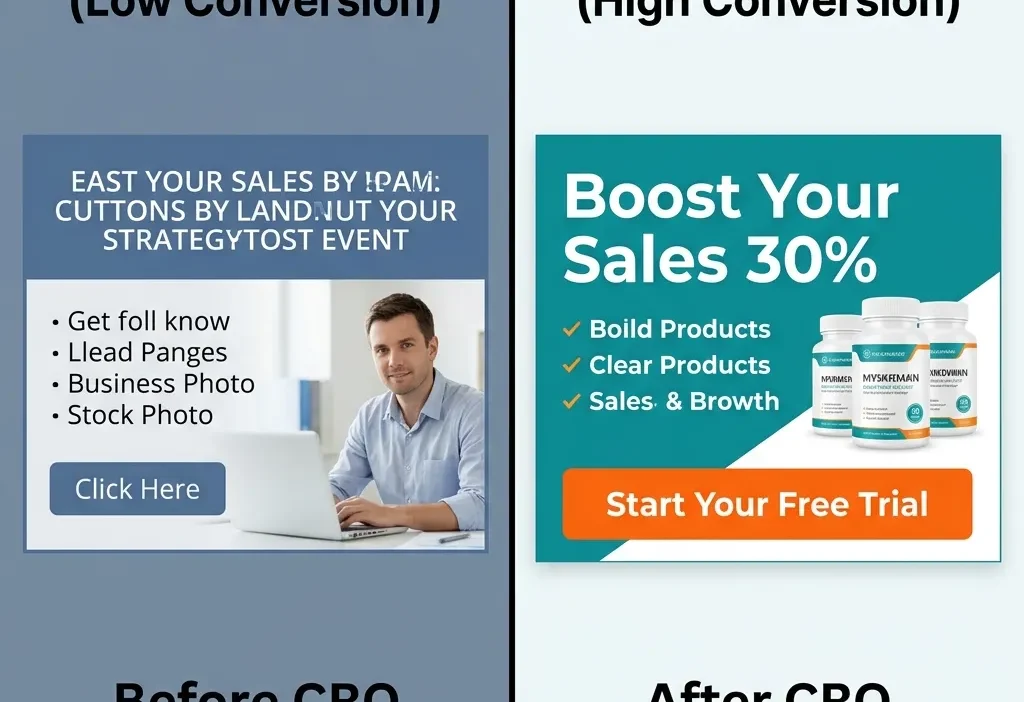
Conversion rate optimization ads are paid campaigns engineered to turn clicks into customers, not just traffic. The best results come from sharp ad copy, precise targeting, conversion tracking, and high-converting landing pages tested continuously across Google, Facebook, and other channels.
Most advertisers obsess over getting more clicks. Smart advertisers obsess over what happens after the click. That difference sits at the heart of conversion rate optimization ads—campaigns designed to move people toward a specific action, whether that’s a purchase, a sign-up, or a booked demo.
This guide walks through everything you need to build, run, and refine conversion rate optimization ads. You’ll learn the core metrics that matter, how to write Google Ads copy that converts, how to craft Facebook Ad Copywriting that stops the scroll, and how to tie it all together with Cross-Channel Advertising. We’ll also look at how time-tested Traditional Advertising principles still shape modern digital campaigns, and finish with 12 practical FAQs.
By the end, you’ll have a clear framework for squeezing more conversions out of every advertising dollar—no guesswork required.
What are conversion rate optimization ads?
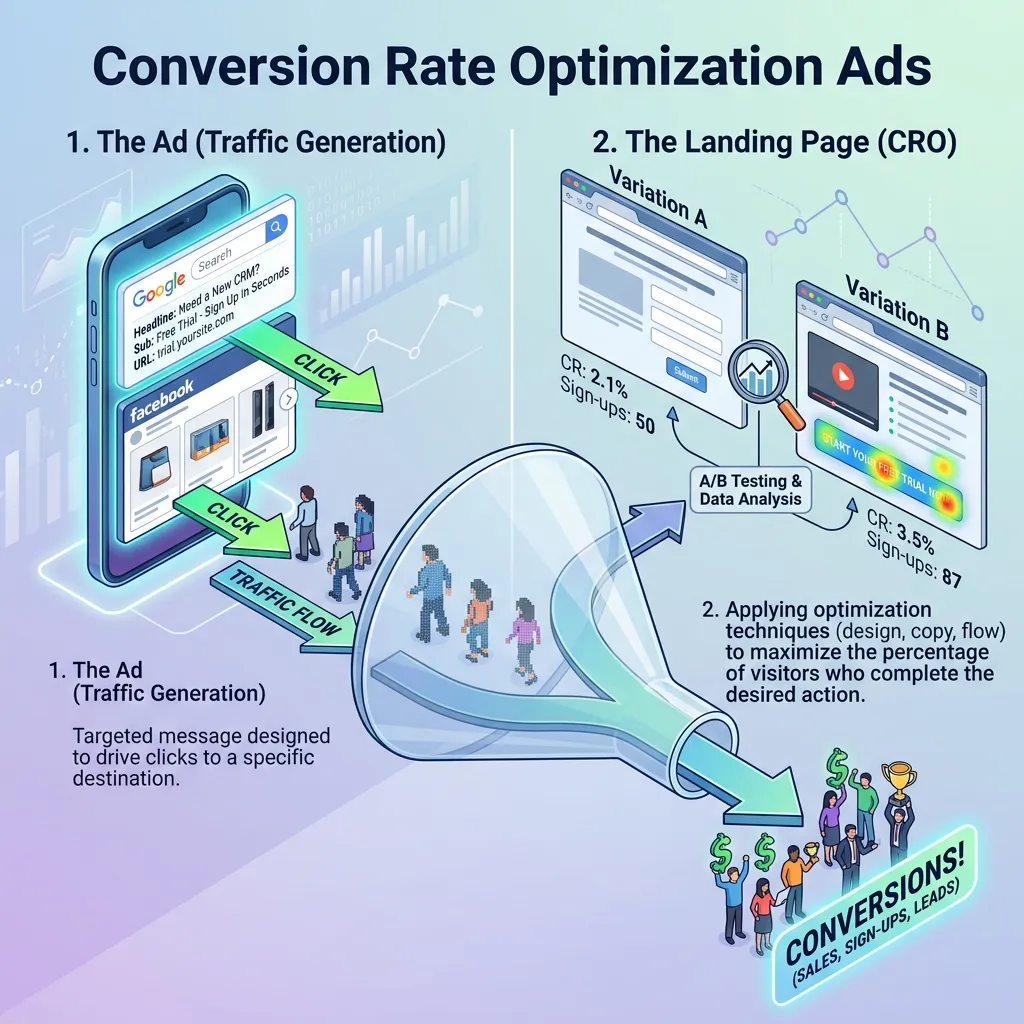
Conversion rate optimization ads are paid advertisements built and tuned to maximize the percentage of viewers who complete a desired action. The “conversion” can be anything measurable: a sale, a lead form submission, a newsletter sign-up, or an app install.
Unlike awareness campaigns that chase impressions, conversion rate optimization ads focus on outcomes. The goal isn’t simply to be seen—it’s to drive results you can count.
Why conversion rate optimization ads are crucial for business growth
Ad budgets are finite. When you improve your conversion rate, you get more customers from the same spend. A campaign that converts at 4% instead of 2% effectively doubles your return without a single extra dollar of media budget.
Conversion rate optimization ads also compound over time. Each test teaches you something about your audience, and those lessons stack up into a durable competitive edge that competitors can’t easily copy.
How conversion rate optimization ads evolved in digital marketing
Early online ads borrowed heavily from print and broadcast—catchy slogans, big logos, broad reach. As tracking technology matured, advertisers gained the ability to measure exactly which ads produced sales. That shift turned advertising from an art of persuasion into a discipline of measurable persuasion. Today, conversion rate optimization ads blend creative instinct with hard data.
Understanding the fundamentals of CRO for advertising
Before you optimize anything, you need to know what you’re measuring and why.
Which key metrics matter most for conversion rate optimization ads?
A handful of numbers tell you whether your conversion rate optimization ads are working:
- Conversion rate: The percentage of clicks that complete your goal action.
- Cost per conversion (CPA): How much you spend to acquire one conversion.
- Click-through rate (CTR): How many people click your ad after seeing it.
- Return on ad spend (ROAS): Revenue earned for every dollar spent.
- Quality Score (on Google Ads): A 1–10 rating of ad relevance, expected CTR, and landing page experience.
Track these together. A high CTR with a low conversion rate, for example, usually points to a mismatch between your ad promise and your landing page.
How do you identify conversion killers in your ad campaigns?
Conversion killers are the friction points that stop people from acting. Common culprits include slow-loading landing pages, confusing calls to action, mismatched messaging between ad and page, and forms that ask for too much information. Audit each step of the journey and look for the place where people drop off.
How to set up conversion tracking for effective conversion rate optimization ads
You can’t optimize what you don’t measure. Install conversion tracking through Google Ads tags, the Meta Pixel, or a tool like Google Tag Manager. Define each conversion clearly, assign a value where possible, and verify that tracking fires correctly before you scale spend. Accurate tracking is the foundation every other tactic rests on.
Mastering Google Ads Copywriting for conversion rate optimization

Google Ads Copywriting rewards clarity and relevance. Searchers already have intent—your job is to confirm you have exactly what they want.
How do you craft compelling headlines and descriptions?
Strong Google Ads Copywriting mirrors the searcher’s query and leads with a benefit. Use numbers, address pain points directly, and include a clear call to action. Front-load your most important keywords so they’re visible even on smaller screens.
Using ad extensions to boost conversion rates
Ad extensions expand your ad and give people more reasons to click. Sitelink extensions point to specific pages, callout extensions highlight perks like “Free Shipping,” and structured snippets showcase product categories. Extensions also increase your ad’s real estate, pushing competitors further down the page.
What A/B testing strategies improve Google Ads performance?
Test one variable at a time so you know what caused the change. Try different headlines, swap calls to action, or experiment with different value propositions. Run each test long enough to reach statistical significance, then keep the winner and challenge it again.
Ad Copy Examples for high-performing Google Ads
Here are a few Ad Copy Examples that demonstrate solid Google Ads Copywriting:
- Headline: “Cut Your Energy Bill by 30%” | Description: “Switch in 5 minutes. No exit fees. Join 50,000 happy customers today.”
- Headline: “Project Management, Simplified” | Description: “Plan, track, and ship faster. Start your free 14-day trial—no card required.”
- Headline: “Same-Day Plumbing Repairs” | Description: “Licensed local plumbers. Upfront pricing. Book online in under 60 seconds.”
Each of these Ad Copy Examples pairs a specific benefit with a frictionless next step—the hallmark of conversion rate optimization ads.
Facebook Ad Copywriting for enhanced conversion rate optimization
Where Google captures existing intent, Facebook creates it. Facebook Ad Copywriting must earn attention from people who weren’t searching for you at all.
How do you design engaging visuals and copy for Facebook ads?
On Facebook, the visual stops the scroll and the copy seals the deal. Lead with a hook in the first line, keep paragraphs short, and write like a human, not a brochure. Effective Facebook Ad Copywriting speaks to a feeling first, then backs it up with proof and a clear action.
What targeting strategies help you reach the right audience?
Facebook’s strength is its targeting. Build custom audiences from your customer list, create lookalike audiences to find similar buyers, and layer interests and behaviors to narrow your reach. The tighter your match between message and audience, the higher your conversion rate.
How do you leverage retargeting for more conversions?
Most people don’t convert on their first visit. Retargeting shows ads to people who already engaged with your brand—visited your site, watched a video, or added an item to cart. Because these audiences already know you, retargeting campaigns typically deliver some of the strongest results in any conversion rate optimization ads strategy.
Cross-Channel Advertising for holistic conversion rate optimization
Customers rarely live on one platform. Cross-Channel Advertising connects the dots across every touchpoint they encounter.
How do you integrate conversion rate optimization ads across platforms?
Map your customer journey and assign each channel a role. Search might capture demand, social might build awareness and retarget, and email might nurture leads toward a sale. When these channels work together, your conversion rate optimization ads reinforce one another instead of competing.
Why does consistent messaging matter in Cross-Channel Advertising?
A prospect who sees one promise on Facebook and a different one on Google gets confused—and confused people don’t convert. Keep your value proposition, tone, and offer consistent across channels. Consistency builds recognition, and recognition builds trust.
What is attribution modeling and why does it matter?
Attribution modeling assigns credit to the touchpoints that lead to a conversion. A last-click model gives all the credit to the final ad, while multi-touch models spread it across the journey. Choosing the right model helps you see which of your conversion rate optimization ads truly drive results, so you can invest accordingly.
The role of landing pages in conversion rate optimization ads
Even brilliant ad copy fails if the landing page disappoints. The page is where conversion actually happens.
How do you design high-converting landing pages?
A high-converting landing page has one clear goal and removes every distraction from it. Use a focused headline that matches the ad, a single prominent call to action, social proof such as reviews, and a fast load time. Every element should push the visitor toward the conversion.
How do you optimize landing page copy and visuals?
Match the page’s language to the ad that brought the visitor there—this is called message match. Use benefit-driven headlines, short scannable copy, and visuals that show the product in action. Test different layouts and CTAs just as you would with your ads.
Why does a seamless ad-to-conversion experience matter?
Every extra step or moment of doubt loses customers. The journey from ad click to confirmation page should feel effortless. When the ad, the landing page, and the offer all align, conversion rate optimization ads perform at their best.
Applying Traditional Advertising principles to digital campaigns
The tools change, but human psychology doesn’t. Traditional Advertising still has plenty to teach digital marketers.
What lessons from Traditional Advertising apply today?
Classic Traditional Advertising taught that a single, clear message beats a cluttered one—the “one ad, one idea” rule. It championed strong headlines, memorable hooks, and a focus on customer benefits over product features. Those same principles power high-converting digital ads today.
How do storytelling and emotional appeal boost conversions?
People buy with emotion and justify with logic. A short story—how a customer solved a problem with your product—creates connection that a feature list never will. Borrowing the narrative craft of Traditional Advertising makes conversion rate optimization ads more persuasive and more memorable.
How do you build trust and credibility through your ads?
Trust drives conversions. Show real reviews, display recognizable badges or certifications, and make honest claims you can back up. Traditional Advertising relied on reputation built over years; digital ads can build that same trust faster with visible social proof.
Advanced strategies for conversion rate optimization ads
Once the fundamentals are solid, these advanced tactics push performance further.
How does personalization improve conversion rate optimization ads?
Dynamic content tailors your ad to each viewer—showing the product they browsed, their city, or an offer matched to their behavior. Personalized conversion rate optimization ads feel relevant, and relevance lifts conversion rates.
How do AI and machine learning support predictive advertising?
AI analyzes patterns across thousands of conversions to predict who is most likely to buy and which creative will perform best. Platform tools like Google’s Performance Max and Meta’s Advantage+ use machine learning to optimize bids and placements automatically, freeing you to focus on strategy and copy.
How do you optimize ads for voice search?
Voice queries tend to be longer and more conversational than typed searches. To future-proof your conversion rate optimization ads, include natural-language phrases and question-based keywords that match how people actually speak.
Measuring and analyzing the performance of conversion rate optimization ads

Optimization is a loop, not a one-time task. Measurement keeps the loop turning.
What tools and analytics help you track CRO?
Google Analytics 4, Google Ads, Meta Ads Manager, and heatmap tools like Hotjar all reveal how people interact with your ads and pages. Together they show not just whether conversions happen, but where and why.
How do you interpret data to refine your ads?
Look for patterns, not single data points. Segment performance by device, audience, and placement to find hidden wins and losses. If mobile converts poorly, your mobile landing page likely needs work. Let the data point you to the next test.
Why does iterative testing drive continuous improvement?
No campaign is ever “finished.” The best advertisers treat every result as a hypothesis for the next experiment. Small, steady improvements compound into major gains over time—which is exactly why conversion rate optimization ads reward patience and consistency.
Final thoughts on winning with conversion rate optimization ads
Conversion rate optimization ads turn advertising from a cost center into a growth engine. The formula is consistent: track the right metrics, write clear and benefit-driven copy, match your message across channels, and send traffic to landing pages built to convert. Layer in time-tested Traditional Advertising wisdom and modern tools like AI, and you have a system that improves with every test.
Start small. Pick one campaign, fix its biggest conversion killer, and run a single A/B test this week. Then do it again. The advertisers who win aren’t the ones with the biggest budgets—they’re the ones who optimize relentlessly.
FAQs about conversion rate optimization ads
What is a good conversion rate for ads?
A “good” conversion rate varies by industry and channel, but the average across Google Ads sits around 3–4%. E-commerce often runs lower (1–3%), while lead-generation campaigns can run higher. Focus less on hitting a universal benchmark and more on beating your own past performance.
How do you calculate conversion rate?
Divide the number of conversions by the number of total interactions (usually clicks), then multiply by 100. For example, 50 conversions from 1,000 clicks equals a 5% conversion rate.
What are the most common mistakes in CRO for ads?
The biggest mistakes include a mismatch between ad and landing page, slow-loading pages, vague calls to action, weak conversion tracking, and changing too many variables at once during testing.
Can CRO be applied to all types of advertising?
Yes. As long as you can define and measure a desired action, you can apply conversion rate optimization. This works for search ads, social ads, display, email, and even offline campaigns with trackable codes or URLs.
What’s the difference between CRO and SEO?
CRO focuses on increasing the percentage of visitors who take a desired action once they arrive. SEO focuses on attracting more organic visitors from search engines. CRO is about quality of conversions; SEO is largely about quantity of traffic.
How important is ad copy in CRO?
Ad copy is critical. Strong Google Ads Copywriting and Facebook Ad Copywriting set the expectation, qualify the audience, and motivate the click. Even great targeting fails if the copy doesn’t connect, which is why studying Ad Copy Examples is so valuable.
What tools are essential for CRO ads?
At minimum, use Google Analytics 4, Google Ads, Meta Ads Manager, and a conversion tracking setup. Add a heatmap tool like Hotjar and an A/B testing platform to deepen your insights.
How often should I A/B test my ads for CRO?
Treat testing as ongoing. Always have at least one experiment running, and let each test reach statistical significance before declaring a winner—typically one to two weeks, depending on your traffic volume.
Does mobile optimization affect conversion rate optimization ads?
Significantly. The majority of ad traffic now comes from mobile devices. If your ads and landing pages aren’t fast and mobile-friendly, your conversion rate optimization ads will underperform no matter how good the copy is.
What is a micro-conversion in the context of ads?
A micro-conversion is a small step toward the main goal—such as signing up for a newsletter, watching a demo video, or adding an item to a cart. Tracking micro-conversions helps you understand the full path to purchase.
How can I improve conversion rates without increasing my ad budget?
Improve your conversion rate by sharpening ad copy, tightening targeting, strengthening message match with landing pages, adding retargeting, and running consistent A/B tests. These changes lift results from the traffic you already pay for.
How do Cross-Channel Advertising and Traditional Advertising work together?
Cross-Channel Advertising distributes a consistent message across digital platforms, while Traditional Advertising principles—clear messaging, emotional storytelling, and trust-building—guide what that message says. Combined, they make conversion rate optimization ads coherent and persuasive everywhere customers see them.