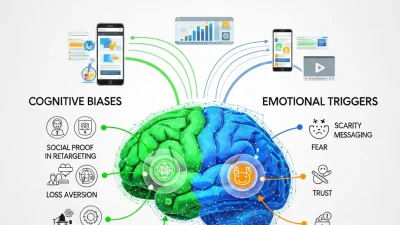
Advertising psychology techniques use principles from behavioral science and cognitive psychology to influence how consumers think, feel, and act. Key methods include emotional storytelling, cognitive biases like scarcity and social proof, and behavioral economics concepts like loss aversion—all of which, when applied ethically, can significantly improve ad performance, ad conversion rate, and overall paid advertising strategy.
Every ad you’ve ever clicked, every product you’ve impulsively bought, every brand you’ve instinctively trusted—psychology had a hand in all of it. Advertising psychology techniques are the invisible architecture behind effective marketing campaigns. They shape perception, trigger emotion, and guide decision-making in ways that most consumers never consciously notice.
Understanding these techniques is no longer optional for marketers. As digital channels become more saturated and consumer attention grows scarcer, the brands that win are those that connect on a psychological level. This is especially critical for paid media, where every impression costs money and every click needs to count.
This guide breaks down the most powerful advertising psychology techniques used across paid campaigns today. From cognitive biases and emotional triggers to behavioral economics and ethical boundaries, you’ll find practical, actionable insights to strengthen your paid advertising strategy—and build campaigns that genuinely resonate.
What Is Advertising Psychology, and Why Does It Matter?
Advertising psychology is the application of psychological principles to the design, targeting, and messaging of ads. It draws from cognitive science, behavioral economics, and social psychology to explain why people respond to certain messages—and ignore others.
At its core, advertising psychology acknowledges a fundamental truth: purchasing decisions are rarely purely rational. According to research published by Harvard Business School professor Gerald Zaltman, approximately 95% of purchasing decisions occur in the subconscious mind. That means the majority of your audience is reacting to feelings, associations, and mental shortcuts—not spreadsheet logic.
For marketers, this has enormous implications. A compelling headline, a well-chosen color, a testimonial from the right voice—these aren’t decorative choices. They’re strategic levers. Mastering advertising psychology techniques allows you to pull those levers deliberately, improving everything from click-through rates to landing page conversion ads performance. learn more : Paid Advertising Strategy
The Power of Emotion in Advertising
How Do Emotions Drive Purchasing Decisions?
Emotions are the primary currency of effective advertising. Neuroscientist Antonio Damasio’s somatic marker hypothesis suggests that emotions are not just influencers of decision-making—they’re prerequisites for it. People with damage to emotional centers of the brain, despite having intact reasoning abilities, struggle to make even simple choices.
Advertisers have long understood this intuitively. Campaigns built around happiness, nostalgia, fear, excitement, or belonging consistently outperform purely informational ads. A 2016 study by the Institute of Practitioners in Advertising (IPA) found that emotional campaigns were nearly twice as effective at driving profit as rational ones.
Techniques to Evoke the Right Emotions
- Nostalgia: Referencing the past creates warmth and trust. Coca-Cola’s holiday campaigns are a masterclass in this.
- Happiness and humor: Positive emotions increase brand likability and sharing behavior.
- Fear and urgency: Used carefully, these prompt immediate action—particularly in health, insurance, and security categories.
- Aspiration: Showing consumers the version of themselves they want to become is a perennial driver of desire.
Why Storytelling Remains the Most Powerful Emotional Lever
Stories activate multiple regions of the brain simultaneously—including areas associated with sensory experience and emotion. When an ad tells a compelling story, the audience doesn’t just observe; they participate emotionally. This is why brands like Nike and Apple invest heavily in narrative-driven campaigns: storytelling converts passive viewers into emotionally invested consumers.
Cognitive Biases and Their Role in Advertising
Cognitive biases are systematic patterns of thinking that cause people to deviate from purely rational decisions. For marketers, these biases are reliable psychological mechanisms that—when understood—can be ethically leveraged to improve campaign performance.
Scarcity and Urgency: How FOMO Drives Action
Scarcity triggers loss aversion and FOMO (fear of missing out), two of the most potent motivators in consumer psychology. Phrases like “Only 3 left in stock” or “Offer ends tonight” create psychological pressure that pushes hesitant buyers toward conversion. Research by Robert Cialdini, author of Influence: The Psychology of Persuasion, consistently identifies scarcity as one of the six core principles of persuasion.
Used authentically, scarcity messaging is a highly effective advertising psychology technique. Used dishonestly, it erodes trust—something we’ll return to in the ethics section.
Social Proof: Why Reviews and Influencers Work
Humans are social animals. When uncertain, we look to others for cues on how to behave. Social proof—testimonials, star ratings, user counts, influencer endorsements—taps directly into this instinct. A BrightLocal survey found that 87% of consumers read online reviews before making a purchase decision. Embedding social proof into your ads and landing page conversion ads dramatically reduces perceived risk and increases conversion confidence.
Authority: Leveraging Expert Credibility
Authority bias leads consumers to trust messages delivered by perceived experts. Featuring a credentialed professional, citing a well-known study, or partnering with a recognized institution can significantly elevate ad credibility. This is especially powerful in categories like health, finance, and technology.
Anchoring: Shaping Value Perception
Anchoring occurs when people rely heavily on the first piece of information they encounter. A product originally priced at $200, now at $99, feels like a bargain—because the $200 figure anchors value perception. Pricing structures, “was/now” comparisons, and tiered plans all exploit anchoring to make the target offer feel more compelling.
Reciprocity: The Psychology of Giving First
Cialdini’s reciprocity principle holds that people feel compelled to return favors. Free trials, samples, valuable content, and exclusive insights create a sense of obligation that nudges consumers toward purchase. This underpins content marketing strategies and is a central pillar of many subscription and SaaS paid advertising strategies.
Behavioral Economics in Advertising
Nudging: Guiding Choices Without Forcing Them
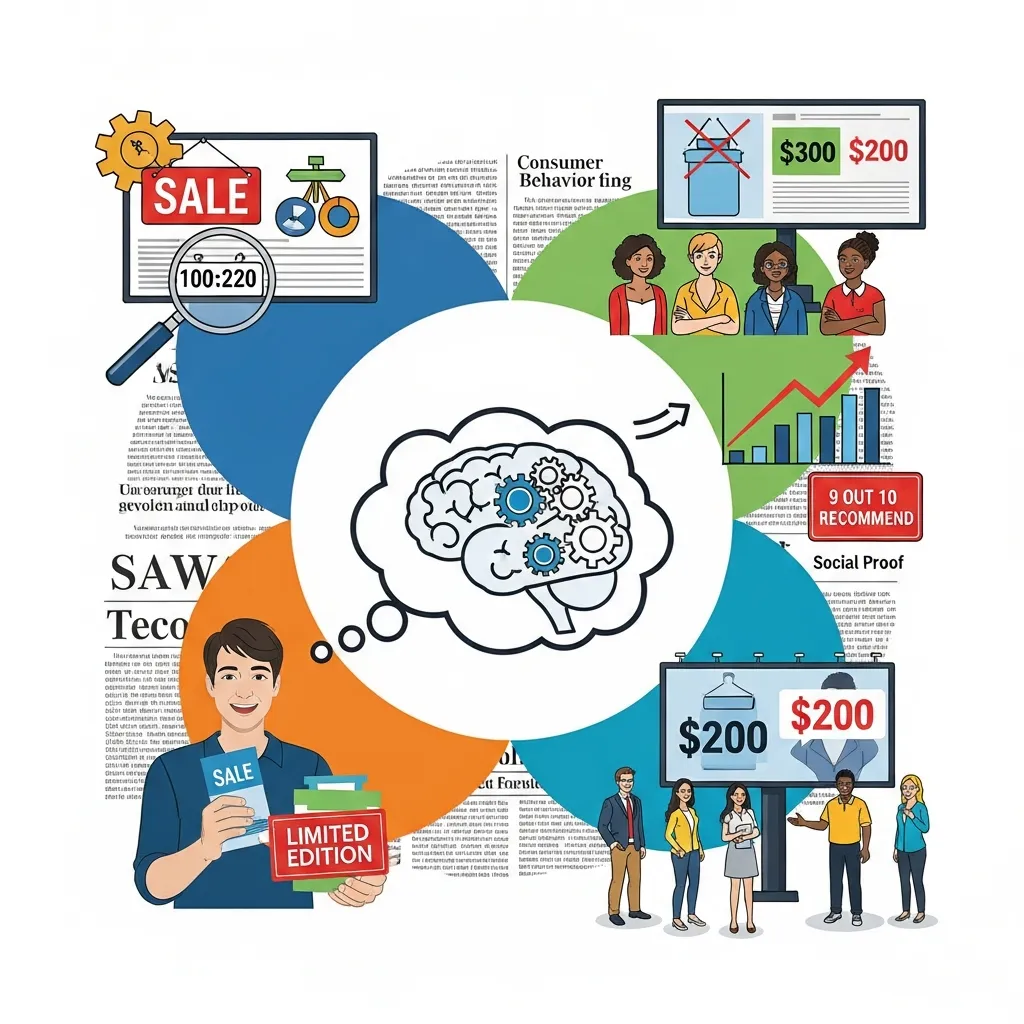
Nudging involves structuring choices to make desired behaviors easier or more appealing—without restricting options. Pre-selected checkboxes, default subscription options, and prominently displayed “most popular” plan badges are all nudges. Popularized by Nobel laureate Richard Thaler and Cass Sunstein in Nudge (2008), this approach is widely used in digital UX and ad design to steer consumers toward conversion.
Framing: Presenting Information Strategically
The same fact, framed differently, produces different responses. “90% fat-free” outperforms “contains 10% fat” even though both statements are identical. Framing shapes interpretation by emphasizing certain aspects of a message over others. In paid advertising, framing applies to ad copy, headlines, landing page messaging, and call-to-action language.
Loss Aversion: Why Fear of Loss Outweighs Desire for Gain
Behavioral economists Daniel Kahneman and Amos Tversky demonstrated that losses feel roughly twice as powerful as equivalent gains. Advertising that emphasizes what a consumer might miss—rather than what they might gain—taps into this asymmetry. “Don’t miss out” converts better than “Gain access” for precisely this reason.
Practical Advertising Psychology Techniques for Paid Media
How to Write Ad Copy That Uses Psychological Triggers
Effective ad copy leads with the reader’s pain point, then offers relief. It uses power words that trigger emotion (free, proven, guaranteed, exclusive), incorporates social proof, and ends with a clear call to action. Headlines should address a specific desire or fear, and body copy should sustain momentum by reinforcing the core emotional appeal.
Designing Visuals That Capture Attention
Visual hierarchy guides the eye. High-contrast colors, human faces (particularly eyes), and directional cues like arrows or gestures all influence where attention lands. Research by 3M found that visuals are processed 60,000 times faster than text. Your ad’s image or video isn’t decoration—it’s your first argument.
Optimizing Landing Page Conversion Ads
Landing pages are where psychological groundwork converts into measurable results. Effective landing page conversion ads maintain message match (the landing page reflects exactly what the ad promised), minimize friction (short forms, clear CTAs), and deploy social proof prominently above the fold. Every element should serve a single conversion goal.
Using A/B Testing to Refine Psychological Advertising
A/B testing allows marketers to pit two psychological approaches against each other—loss-framed copy versus gain-framed copy, testimonial-led versus feature-led—and let real audience behavior determine the winner. Continuous A/B testing is how good campaigns become great ones. Analyzing your ad conversion rate across variants reveals which psychological triggers are resonating with your specific audience.
Analyzing Ad Conversion Rate Through a Psychological Lens
Ad conversion rate is more than a performance metric—it’s diagnostic feedback about how well your psychological framing is working. Low conversion rates on high-traffic campaigns often signal a disconnect between the emotional promise of the ad and the experience on the landing page. Psychological consistency across the full funnel is essential.
Understanding Your Audience: The Foundation of Psychological Advertising
No psychological technique works in isolation from audience understanding. Market research—through surveys, interviews, behavioral data, and social listening—reveals the specific fears, desires, and motivations of your target segments. This intelligence informs which psychological levers to pull.
Consumer segmentation goes beyond demographics. Psychographic segmentation groups audiences by values, attitudes, and lifestyle—allowing advertisers to craft messages that feel personally relevant. An ad that speaks directly to a reader’s identity (“For those who refuse to settle for average”) performs markedly better than one that addresses a generic audience.
Pain point mapping is particularly valuable in paid media. When you know exactly what keeps your audience up at night, you can address that anxiety directly in your ad copy—and position your product as the resolution.
Ethical Considerations in Advertising Psychology

Where Does Persuasion End and Manipulation Begin?
The line between persuasion and manipulation lies in transparency and intent. Ethical advertising psychology techniques work by genuinely helping consumers make decisions that serve their interests. Manipulation, by contrast, exploits vulnerabilities or misrepresents reality to serve the advertiser at the consumer’s expense.
False scarcity, fabricated reviews, and deceptive framing are not advertising psychology—they are short-term tactics with long-term consequences. The FTC actively monitors misleading advertising claims, and consumer trust, once broken, is extraordinarily difficult to rebuild.
Building Trust Through Transparency
The most durable winning paid media strategy is one built on honesty. Brands that disclose sponsorships clearly, back claims with evidence, and deliver on their advertising promises build compounding brand equity. Trust is itself a psychological asset—and one of the most powerful conversion drivers available.
Conclusion
Advertising psychology techniques are among the most valuable tools available to modern marketers. Emotion, cognitive bias, and behavioral economics don’t just explain why consumers act—they provide a blueprint for building campaigns that consistently perform. From crafting psychologically resonant ad copy to optimizing landing page conversion ads and tracking ad conversion rate improvements, every element of a paid advertising strategy can be sharpened by a deeper understanding of the human mind.
The most important takeaway? Psychology works best when it’s used in service of the consumer, not against them. As marketing trends in digital advertising continue to evolve—with AI-driven personalization, predictive targeting, and new ad formats reshaping the landscape—the brands that win will be those that combine psychological sophistication with genuine respect for their audience.
A winning paid media strategy is built on both: the science of how people think, and the integrity to use that knowledge responsibly.
Frequently Asked Questions
1. What are Advertising Psychology Techniques?
Advertising Psychology Techniques are marketing strategies based on behavioral science, consumer psychology, and cognitive bias. These techniques help brands influence how people notice, interpret, trust, and respond to ads. Common Advertising Psychology Techniques include social proof, scarcity, urgency, emotional storytelling, authority cues, reciprocity, and anchoring.
2. How do Advertising Psychology Techniques improve ad performance?
Advertising Psychology Techniques improve ad performance by aligning your messaging with how people actually make decisions. Most consumers do not respond to ads through logic alone—they react emotionally, subconsciously, and contextually. When used well, Advertising Psychology Techniques can improve attention, trust, click-through rate, and ad conversion rate.
3. Which cognitive biases are most commonly used in Advertising Psychology Techniques?
Many Advertising Psychology Techniques rely on cognitive biases such as scarcity bias, social proof, loss aversion, anchoring, reciprocity, and authority bias. These patterns influence consumer judgment and help explain why certain ads feel more persuasive. The most effective Advertising Psychology Techniques use these biases ethically and strategically.
4. Are Advertising Psychology Techniques ethical to use in marketing?
Yes, Advertising Psychology Techniques are ethical when they are used honestly and transparently to improve communication, reduce confusion, and help consumers make decisions. Advertising Psychology Techniques become unethical when they rely on deception, fake urgency, misleading claims, or exploit vulnerable audiences.
5. How does social proof work in Advertising Psychology Techniques?
Social proof is one of the most powerful Advertising Psychology Techniques because it reduces uncertainty and perceived risk. When consumers see testimonials, reviews, user-generated content, or influencer recommendations, they feel more confident about a purchase decision. This is why social proof is a core part of many Advertising Psychology Techniques used in paid ads and landing pages.
6. Why is emotion so important in Advertising Psychology Techniques?
Emotion is central to Advertising Psychology Techniques because buying decisions are often driven by feelings before logic catches up. Great ads use Advertising Psychology Techniques to trigger aspiration, trust, relief, urgency, nostalgia, or excitement. Emotional relevance helps people remember your message and makes your advertising more persuasive.
7. How can I use scarcity and urgency in Advertising Psychology Techniques?
Scarcity and urgency are highly effective Advertising Psychology Techniques when they are based on real limitations, such as low stock, time-sensitive pricing, or limited registration windows. The key is to use these Advertising Psychology Techniques honestly rather than creating fake pressure. Real urgency can increase action, while fake urgency damages trust.
8. Can Advertising Psychology Techniques improve landing page conversion ads?
Yes, Advertising Psychology Techniques are extremely useful for landing page conversion ads. They help improve message clarity, reduce friction, strengthen trust, and guide visitors toward one specific action. Using Advertising Psychology Techniques like social proof, benefit framing, CTA psychology, and trust signals can significantly improve landing page performance.
9. How do Advertising Psychology Techniques help improve ad conversion rate?
To improve ad conversion rate, Advertising Psychology Techniques should be used consistently across the full funnel—from ad creative to landing page to call-to-action. If your ad creates urgency, your landing page should reinforce that urgency. If your ad uses emotional storytelling, your landing page should continue the same emotional narrative. This consistency makes Advertising Psychology Techniques far more effective.
10. What marketing trends in digital advertising are shaped by Advertising Psychology Techniques?
Many modern marketing trends are deeply influenced by Advertising Psychology Techniques, including AI personalization, emotional storytelling, community-led branding, interactive ad formats, and values-based messaging. These trends work because Advertising Psychology Techniques help brands create more relevant and emotionally resonant ad experiences.
11. How does A/B testing support Advertising Psychology Techniques?
A/B testing helps you validate which Advertising Psychology Techniques actually work for your audience. For example, you can test whether urgency performs better than social proof, or whether fear of loss converts better than aspirational messaging. Instead of guessing, A/B testing turns Advertising Psychology Techniques into measurable, data-backed decisions.
12. What makes a paid media strategy effective when using Advertising Psychology Techniques?
A strong paid media strategy uses Advertising Psychology Techniques at every stage: audience targeting, creative messaging, offer framing, landing page design, and CTA placement. The best Advertising Psychology Techniques do not just attract clicks—they create trust, reduce resistance, and move the customer toward action in a way that feels natural and persuasive.