Landing page conversion ads combine targeted ad copy with optimized landing pages to turn clicks into customers. Success depends on audience alignment, persuasive Google Ads copywriting, mobile-friendly design, and continuous A/B testing. Businesses that align their ad messaging with their landing page content consistently see higher conversion rates and lower cost-per-acquisition.
Every click on your ad costs money. The question is: what happens after that click?
Most businesses pour resources into getting traffic—tweaking bids, refining audiences, testing ad creatives. But the landing page, the place where clicks either convert or disappear, often gets treated as an afterthought. That disconnect is where most digital advertising budgets go to waste.
Landing page conversion ads are the bridge between attention and action. When your ad copy and landing page work in sync, you’re not just driving traffic—you’re guiding people through a deliberate experience designed to produce a specific outcome. Done well, landing page conversion ads can dramatically lower your cost-per-click (CPC), raise your Quality Score on Google Ads, and turn a mediocre campaign into a reliable revenue machine.
This guide covers everything you need to know: from understanding your audience and crafting persuasive ad copywriting to advanced conversion rate optimization strategies and the role of AI in modern digital advertising. Whether you’re running your first Google Ads campaign or refining a mature marketing funnel, the tactics here are built to produce results.
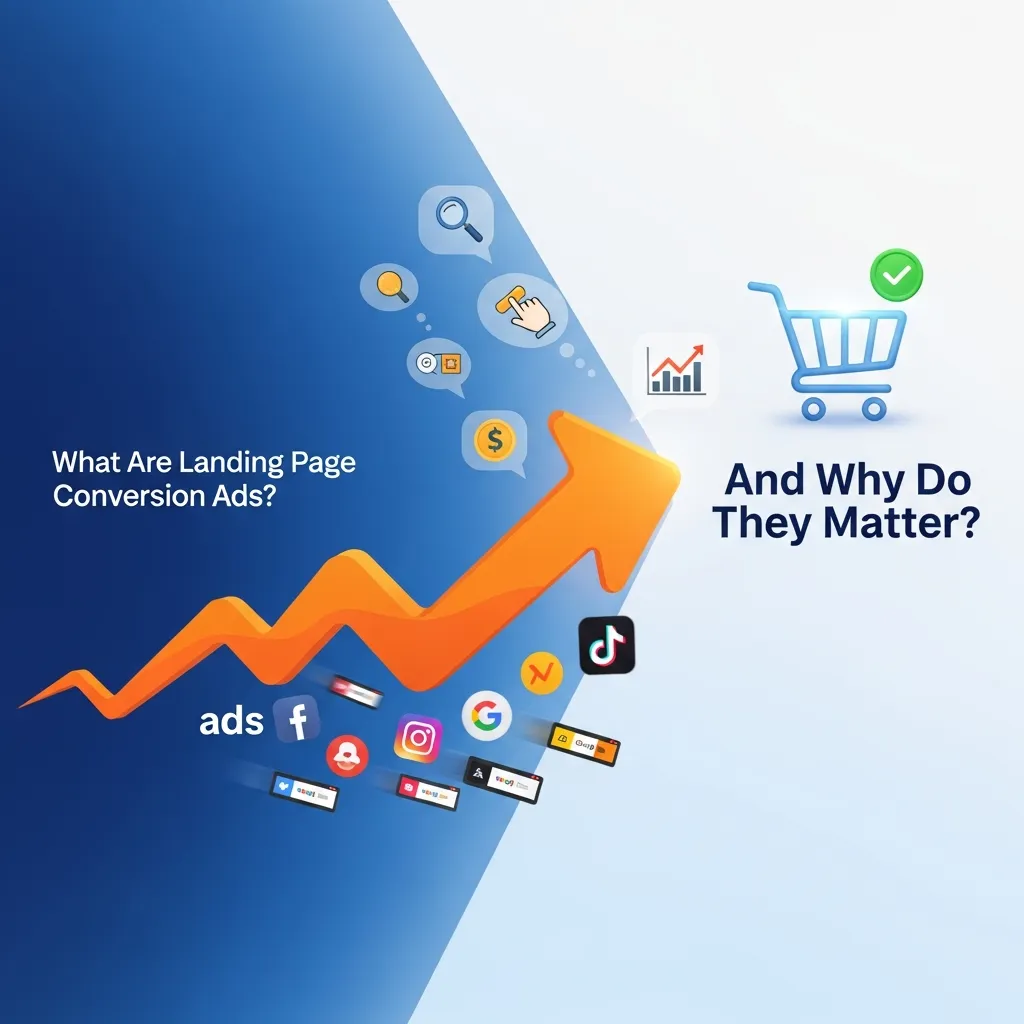
I. What Are Landing Page Conversion Ads, and Why Do They Matter?
What are landing page conversion ads?
Landing page conversion ads are paid advertisements—typically run through platforms like Google Ads, Meta, or LinkedIn—that direct users to a dedicated landing page designed to achieve a single, measurable goal. That goal might be a form submission, a product purchase, a phone call, or a free trial sign-up.
Unlike a homepage or a general product page, a landing page is purpose-built. It has no navigation menus pulling visitors away, no competing offers diluting the message. Every element—the headline, the imagery, the copy, the call to action—exists to support one outcome.
Why are landing page conversion ads crucial for digital marketing success?
The math is straightforward. If your ad drives 1,000 clicks at $2.00 each, you’ve spent $2,000. A 2% conversion rate produces 20 conversions. Improve that rate to 4%, and you’ve doubled your results without spending another dollar.
That’s the power of conversion rate optimization (CRO). According to WordStream, the average landing page conversion rate across industries is around 2.35%, but the top 25% of advertisers consistently achieve 5.31% or higher. The gap between average and excellent isn’t luck—it’s strategy.
The interplay between landing pages and ad copy
Google’s Quality Score is a direct measure of ad relevance and landing page experience. A high Quality Score reduces your cost-per-click and improves your ad placement. Achieving it requires that your ad copy and landing page speak the same language—literally. The keywords in your ad should appear on your landing page. The promise your ad makes should be fulfilled the moment someone arrives.
Message match isn’t just good for Quality Scores. It’s good for trust. When users click an ad about “free CRM software” and land on a page about enterprise pricing, they bounce. When the message is consistent, they stay—and they convert.
II. Understanding Your Audience and Their Journey
How do you identify your target demographic for landing page conversion ads?
Before you write a single word of ad copy, you need to know who you’re writing for. Demographics (age, location, income) are a starting point, but psychographics—values, pain points, motivations—are where the real insight lives.
Build detailed buyer personas using data from your CRM, customer interviews, and tools like Google Analytics and Meta Audience Insights. Ask: what problem does this person have, and how does your product solve it?
How does mapping the customer journey improve landing page performance?
A user searching “best project management software” is in a very different mindset than someone searching “Asana vs Monday pricing.” The first is exploring. The second is close to a decision. Your landing page conversion ads should reflect that distinction.
Map your customer journey into stages: awareness, consideration, and decision. Then match your landing page content to each stage. Awareness-stage visitors need education. Decision-stage visitors need reassurance—think testimonials, guarantees, and clear pricing.
How should you tailor landing page content to user intent?
User intent is the “why” behind a search query. Google categorizes intent as informational, navigational, commercial, or transactional. For landing page conversion ads, you’re almost always targeting commercial or transactional intent. Your page should confirm immediately that the user is in the right place—with a headline that mirrors their search intent and a value proposition that answers “what’s in it for me?” within three seconds.
III. Crafting Compelling Ad Copy (Google Ads Copywriting)
What are the principles of persuasive ad copywriting?
Persuasive ad copywriting is built on clarity, relevance, and urgency. Your headline should capture attention. Your description should build desire. Your call to action should remove friction.
A few principles that consistently improve performance:
- Lead with the benefit, not the feature. “Save 3 hours a week” outperforms “Automated scheduling tool.”
- Use specific numbers. “Join 12,000 marketers” is more convincing than “Join thousands of marketers.”
- Create urgency without being gimmicky. “Offer ends Friday” works. “ACT NOW” doesn’t.
- Mirror the searcher’s language. Use the exact words your audience uses to describe their problem.
How do you utilize keywords effectively in ad copy for Google Ads?
Keywords in Google Ads copywriting serve two purposes: they trigger your ad, and they signal relevance to both the user and Google’s algorithm. Include your primary keyword—landing page conversion ads—in your headline and, where natural, in your description. But avoid keyword stuffing. Copy that reads like a keyword list converts poorly, and Google’s systems are sophisticated enough to penalize it.
Dynamic Keyword Insertion (DKI) is a useful feature in Google Ads that automatically inserts the user’s search query into your ad copy. Used carefully, it can significantly improve click-through rates (CTR) by making ads feel highly relevant to the searcher.
Why is A/B testing ad variations essential for optimal performance?
No copywriter—no matter how experienced—gets it right on the first draft. A/B testing ad variations means running two versions of an ad simultaneously to determine which performs better on a specific metric (CTR, conversion rate, cost-per-conversion).
Google Ads makes this relatively straightforward through its ad variation and campaign experiment tools. Test one variable at a time—a headline, a CTA, a value proposition—so you can isolate what’s actually driving the difference. Over time, the compounding effect of incremental improvements is substantial.
IV. Designing High-Converting Landing Pages
What are the key elements of a successful landing page?
A high-converting landing page has a clear structure. Every element earns its place. Here’s what the research and experience consistently show:
- A benefit-driven headline that matches the ad’s promise
- A concise sub-headline that elaborates on the value proposition
- Hero imagery or video that shows the product or outcome in context
- Social proof—testimonials, logos, review scores—positioned near the CTA
- A single, prominent call to action with action-oriented copy (“Start my free trial,” not “Submit”)
- Trust signals—security badges, money-back guarantees, privacy statements
Remove everything that doesn’t serve the conversion goal. Navigation links, social media icons, and unrelated content all create exit opportunities.
Why is mobile responsiveness critical for landing page conversion ads?
According to Statista, mobile devices account for over 60% of global web traffic. A landing page that loads slowly or displays poorly on a smartphone will bleed conversions regardless of how good the ad copy is. Google’s PageSpeed Insights tool measures both desktop and mobile performance—aim for a score above 90 on mobile.
Specific mobile optimizations include: compressing images, minimizing JavaScript, using tap-friendly button sizes, and ensuring forms are short and easy to complete on a touchscreen.
What makes a call to action (CTA) effective on a landing page?
The CTA is the tipping point between interest and action. High-performing CTAs share three qualities: they’re specific (“Download the free guide”), they’re low-friction (“No credit card required”), and they’re visually prominent. Use a contrasting color for the CTA button, place it above the fold, and repeat it further down the page for visitors who scroll before deciding.
V. Conversion Rate Optimization (CRO) Strategies for Landing Pages
How do you analyze user behavior to improve landing page conversion rates?
Conversion rate optimization starts with understanding what users actually do on your page—not what you assume they do. Tools like Microsoft Clarity, Hotjar, and Google Analytics 4 provide heatmaps, session recordings, and behavior flow reports that reveal where users click, how far they scroll, and where they drop off.
High exit rates at a specific section of the page signal a problem. Maybe the copy is confusing, the load time is slow at that point, or a form field is asking for too much information. Data makes these problems visible and actionable.
What’s the difference between A/B testing and multivariate testing for CRO?
A/B testing compares two versions of a page or element. Multivariate testing tests multiple elements simultaneously—headline, image, and CTA all at once—to identify which combination produces the best result. A/B testing is better suited to pages with lower traffic volumes, since it requires fewer visitors to reach statistical significance. Multivariate testing delivers richer insights but requires significantly more traffic to produce reliable results.
What personalization techniques boost conversion rates on landing pages?
Personalization means delivering content that feels relevant to the individual user. In practice, this includes:
- Geographic personalization: Displaying the user’s city or region (“Available in Austin”)
- Referral source customization: Showing different messaging to visitors from Google vs. those from an email campaign
- Behavioral targeting: Tailoring content based on a user’s previous interactions with your brand
Studies from Epsilon suggest that 80% of consumers are more likely to do business with a company that offers personalized experiences. For landing page conversion ads, personalization is increasingly a baseline expectation, not a differentiator.
VI. Integrating Landing Page Conversion Ads With Your Overall Marketing Strategy
How should landing page conversion ads align with broader marketing goals?
Landing page conversion ads don’t operate in isolation. They’re one touchpoint in a broader customer journey. An ad promoting a free trial sits within a retention funnel. A product launch ad feeds into a revenue goal. Alignment means that the metrics you track for your landing page conversion ads—CPL, ROAS, conversion rate—connect directly to business outcomes, not just campaign-level performance.
Collaboration between paid media, content, and product teams prevents the common problem of ads making promises that the product experience can’t keep.
What metrics should you track to measure the success of landing page conversion ads?
The essential metrics for landing page conversion ads include:
- Conversion rate: The percentage of visitors who complete the desired action
- Cost per conversion (CPC or CPL): The total ad spend divided by the number of conversions
- Quality Score (Google Ads): A measure of ad relevance, expected CTR, and landing page experience
- Bounce rate: The percentage of visitors who leave without interacting
- Return on ad spend (ROAS): Revenue generated divided by advertising costs
Track these in a unified dashboard—Google Looker Studio is a free option—so you can see the full picture without switching between platforms.
VII. Advanced Tactics for Maximizing Landing Page Conversions
How do remarketing campaigns improve landing page conversion rates?
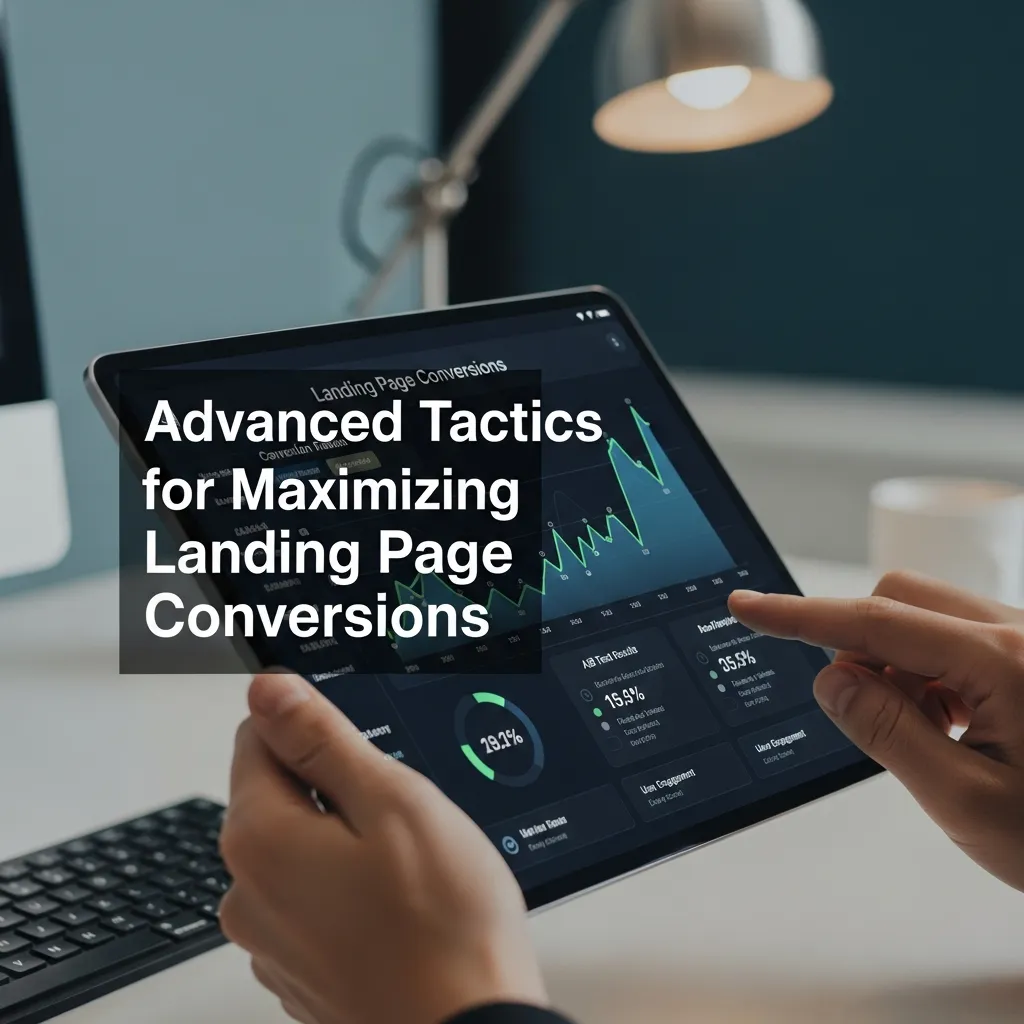
Remarketing campaigns target users who have previously visited your landing page but didn’t convert. According to Google, site visitors who are retargeted are 70% more likely to convert. Remarketing allows you to show tailored ads—perhaps addressing a common objection, or offering a limited-time incentive—to an audience that has already demonstrated interest.
For remarketing to work, your landing page must have a Google Ads or Meta pixel installed, and your remarketing audience must meet minimum size thresholds.
What role does dynamic content play in landing page optimization?
Dynamic content changes based on who is viewing the page. A visitor arriving from a Google search for “HR software for small businesses” might see a headline that says “The HR Platform Built for Small Teams,” while a visitor from a LinkedIn campaign targeting enterprise buyers sees “Enterprise-Grade HR, Simplified.”
Tools like Unbounce’s Smart Traffic, Optimizely, and HubSpot’s personalization features make dynamic landing pages accessible without requiring custom development. The impact on conversion rate optimization can be significant—particularly for businesses serving multiple distinct audience segments.
What is the role of AI in optimizing landing page conversion ads?
AI is changing the economics of conversion rate optimization. Platforms like Google’s Performance Max use machine learning to automatically test ad combinations, adjust bids, and allocate budget toward the highest-performing placements. AI-powered tools like Jasper and Copy.ai accelerate the creation of ad copy variations. Predictive analytics tools can model which landing page elements are most likely to influence conversion before a test is even run.
AI doesn’t replace strategic thinking—it amplifies it. Advertisers who understand the fundamentals of persuasive ad copywriting and landing page design are better positioned to direct AI tools effectively and interpret the results they produce.
Conclusion
Landing page conversion ads reward precision. The businesses that win aren’t always those with the biggest budgets—they’re the ones that understand their audience deeply, match their messaging meticulously, and optimize relentlessly.
Start with the fundamentals: align your ad copy with your landing page, define one clear conversion goal, and make the path to that goal frictionless. Layer in A/B testing, behavior analytics, and personalization as your campaigns mature. And keep an eye on where AI tools can accelerate your process without replacing the strategic judgment that makes conversion rate optimization work.
Every landing page is a hypothesis. Every test is data. The goal is to keep refining until the numbers tell you you’ve got it right—and then keep going.
Frequently Asked Questions (FAQs)
What is a good conversion rate for landing page conversion ads?
The average landing page conversion rate is around 2.35% across industries, according to WordStream. A good benchmark to aim for is 5%+, which puts you in the top quartile of advertisers. Rates above 10% are achievable with strong audience targeting, message match, and continuous optimization.
How often should I update my landing page content?
Update your landing page whenever performance data signals a drop in conversions, when your offer changes, or at least every quarter. Seasonal relevance and fresh social proof (recent testimonials, updated review scores) can meaningfully improve conversion rates without a full redesign.
What are the most common mistakes in landing page design?
The most common mistakes include: having multiple CTAs that compete for attention, poor message match between the ad and the landing page, slow load times (especially on mobile), insufficient social proof, and forms that ask for too much information too early. Each of these creates friction that reduces conversion rates.
How do keywords impact landing page conversion ads?
Keywords affect both your Google Ads Quality Score and your landing page’s relevance signal. Including your target keyword in the landing page headline, body copy, and meta title helps Google confirm that the page delivers on the ad’s promise. This can lower your CPC and improve ad placement, making your budget go further.
Can A/B testing really make a significant difference to conversion rates?
Yes—consistently. Even small changes, like rewording a CTA from “Get Started” to “Start My Free Trial,” can shift conversion rates by 10–30%. The compounding effect of running regular tests over months means that disciplined A/B testing is one of the highest-ROI activities in conversion rate optimization.
What tools are essential for landing page optimization?
Core tools include: Google Analytics 4 (traffic and behavior analysis), Google Optimize or VWO (A/B testing), Hotjar or Microsoft Clarity (heatmaps and session recordings), Unbounce or Instapage (landing page building), and Google PageSpeed Insights (performance testing). For Google Ads copywriting, tools like Jasper can accelerate ad variation creation.
How do I ensure my landing pages are mobile-friendly?
Use a responsive design framework, keep forms to three fields or fewer on mobile, compress all images, and avoid pop-ups that are difficult to dismiss on small screens. Test your landing page on multiple devices and screen sizes before launch, and monitor mobile vs. desktop conversion rates separately in your analytics.
What is the role of trust signals on a landing page?
Trust signals reduce perceived risk and increase the likelihood of conversion. Examples include SSL certificates, money-back guarantees, customer testimonials with real names and photos, industry awards, and recognizable client logos. Position trust signals near your CTA, where hesitation is highest.
How can I reduce bounce rates on my landing pages?
Reduce bounce rates by ensuring strong message match between your ad and landing page, improving page load speed, placing your most compelling content above the fold, and making your CTA immediately visible. Exit-intent popups with a secondary offer can also capture visitors who would otherwise leave.
Is it better to have a short or long landing page?
It depends on the complexity of the offer. Short-form pages (under 500 words) work well for simple, low-commitment actions like email sign-ups. Long-form pages are more effective for high-ticket products or services where visitors need more information to make a decision. The right length is whatever it takes to answer every meaningful objection before the CTA.
How does user experience (UX) affect conversion rates on landing pages?
Poor UX creates friction—slow load times, confusing layouts, unclear CTAs—and friction kills conversions. Good UX removes every unnecessary step between arrival and action. According to Forrester Research, a well-designed user interface can increase conversion rates by up to 200%. Invest in UX as a direct conversion rate optimization lever, not just an aesthetic consideration.
What’s the relationship between SEO and landing page conversion ads?
For paid campaigns, SEO is less directly relevant than Quality Score and message match. However, landing pages that are also optimized for organic search—with clear structure, fast load times, and relevant keyword use—can generate conversion-ready traffic at no additional cost. Over time, building organic visibility for high-intent keywords complements your paid landing page conversion ads strategy and reduces overall customer acquisition costs.