Facebook ad copywriting is the craft of writing persuasive text that grabs attention, sparks emotion, and drives action within Facebook ads. The best copy speaks directly to a defined audience, opens with a strong hook, highlights clear benefits, and ends with a single, compelling call to action.
Most Facebook ads fail not because of bad design or targeting, but because of weak words. You can have a stunning image and a generous budget, yet still lose your audience in the first three seconds if your copy falls flat. Strong writing is what turns a casual scroll into a click—and a click into a customer.
That’s the heart of effective Facebook ad copywriting. It blends a clear understanding of your audience with proven persuasion techniques, all packed into a few short lines. Get it right, and your cost-per-click drops while your return on ad spend climbs.
This guide breaks down everything you need to write ads that convert. You’ll learn how to research your audience, structure high-performing copy, apply advanced strategies like storytelling and social proof, and measure what’s working. By the end, you’ll have a repeatable framework you can use for every campaign you run.
Why Facebook Ad Copywriting Matters More Than Ever
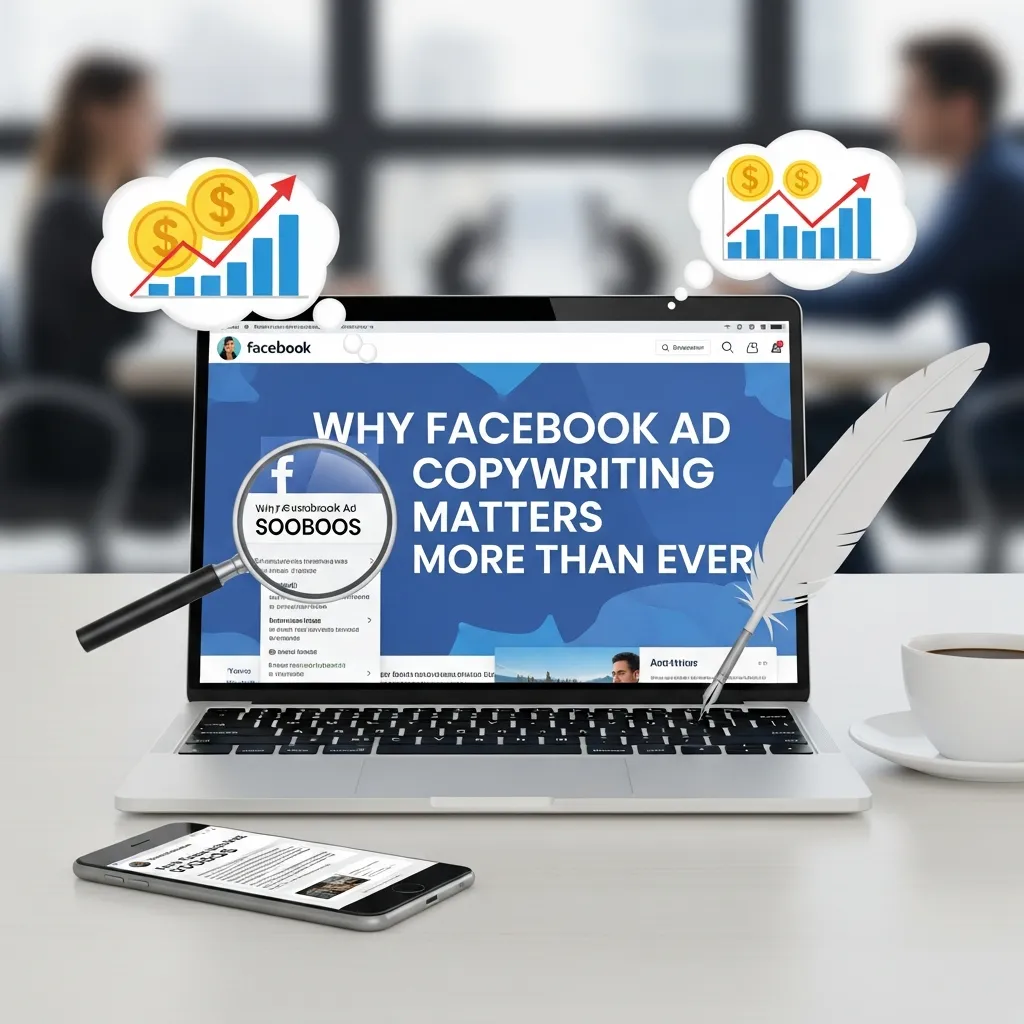
With over 3 billion monthly active users on Facebook, the platform remains one of the largest advertising channels in the world. But that scale comes with fierce competition. Users see hundreds of ads a day, and their attention is the scarcest resource you’re fighting for.
Good Facebook ad copywriting cuts through that noise. It’s the difference between an ad people skip and one they stop to read. As ad costs rise, the brands that win are those that say the right thing to the right person at the right moment. Words do that work.
Strong copy also lowers your costs. Facebook rewards ads with high engagement by showing them more often at a lower price. So persuasive writing doesn’t just improve conversions—it makes your entire budget stretch further.
Understanding Your Audience for Effective Facebook Ad Copywriting
Great copy starts long before you write a single word. It begins with knowing exactly who you’re talking to.
How do you define your target persona?
A target persona is a detailed profile of your ideal customer. It includes demographics like age, location, and job title, but the real value lies in the deeper details: their goals, frustrations, daily habits, and the language they use.
Start by reviewing your existing customers. Read their reviews, support tickets, and social comments. Note the exact phrases they use to describe their problems. When your ad copy mirrors that language, readers feel understood—and people buy from brands that get them.
What is the psychology behind consumer behavior?
People rarely make purchases based on logic alone. Most buying decisions are driven by emotion and then justified with reason. Understanding a few core psychological triggers helps you write copy that connects:
- Loss aversion: People fear missing out more than they value gaining something. Highlight what they stand to lose by not acting.
- Social proof: We look to others to decide what’s safe or worthwhile. Reviews, ratings, and customer counts build trust fast.
- Reciprocity: Offering something valuable first—a free guide, a discount, a tip—makes people more likely to give back.
Tailoring your message: mastering emotional marketing
Mastering emotional marketing means tapping into the feelings that drive your audience to act. Fear, joy, belonging, pride, and relief are powerful motivators. Instead of listing features, paint a picture of how life looks after using your product.
For example, a budgeting app shouldn’t just say “track your spending.” It should say “finally stop wondering where your money went.” The first describes a feature. The second speaks to a feeling—and feelings sell.
The Anatomy of High-Converting Facebook Ad Copy
Every winning ad shares the same building blocks. Master each one, and you’ll have a reliable formula for results.
How do you craft compelling headlines?
Your headline often appears in bold beneath your image, and it carries enormous weight. Keep it short, specific, and benefit-driven. A strong headline answers one question: “What’s in it for me?”
Compare these two:
- Weak: “Our New Running Shoes”
- Strong: “Run Longer With Zero Knee Pain”
The second names a clear, desirable outcome. That’s what earns the click.
Why does the opening hook matter so much?
The first line of your primary text is the most important sentence you’ll write. Facebook truncates copy after a couple of lines, so your hook must earn the “See more” click.
Effective hooks often use a question, a bold statement, or a surprising statistic. Try lines like “Struggling to get clients?” or “We wasted $10,000 on ads before learning this.” Curiosity and relevance pull readers in.
Writing body copy that’s engaging, informative, and persuasive
Once you’ve hooked your reader, the body copy keeps them moving toward action. This is where persuasive ad copywriting earns its keep. Focus on benefits over features, keep sentences short, and build a logical flow from problem to solution.
A simple, reliable structure is PAS:
- Problem: Name the pain your audience feels.
- Agitate: Show why that problem hurts or what it costs.
- Solution: Present your product as the clear fix.
Keep paragraphs to one or two lines. White space makes mobile copy easy to scan.
How do you write a call to action that converts?
Your call to action (CTA) tells readers exactly what to do next. Be direct and specific. “Shop the sale now” beats “Learn more” because it sets a clear expectation.
Pair your text CTA with the matching Facebook button (Shop Now, Sign Up, Get Offer). When both point to the same action, you reduce friction and boost click-through rates.
Advanced Facebook Ad Copywriting Strategies
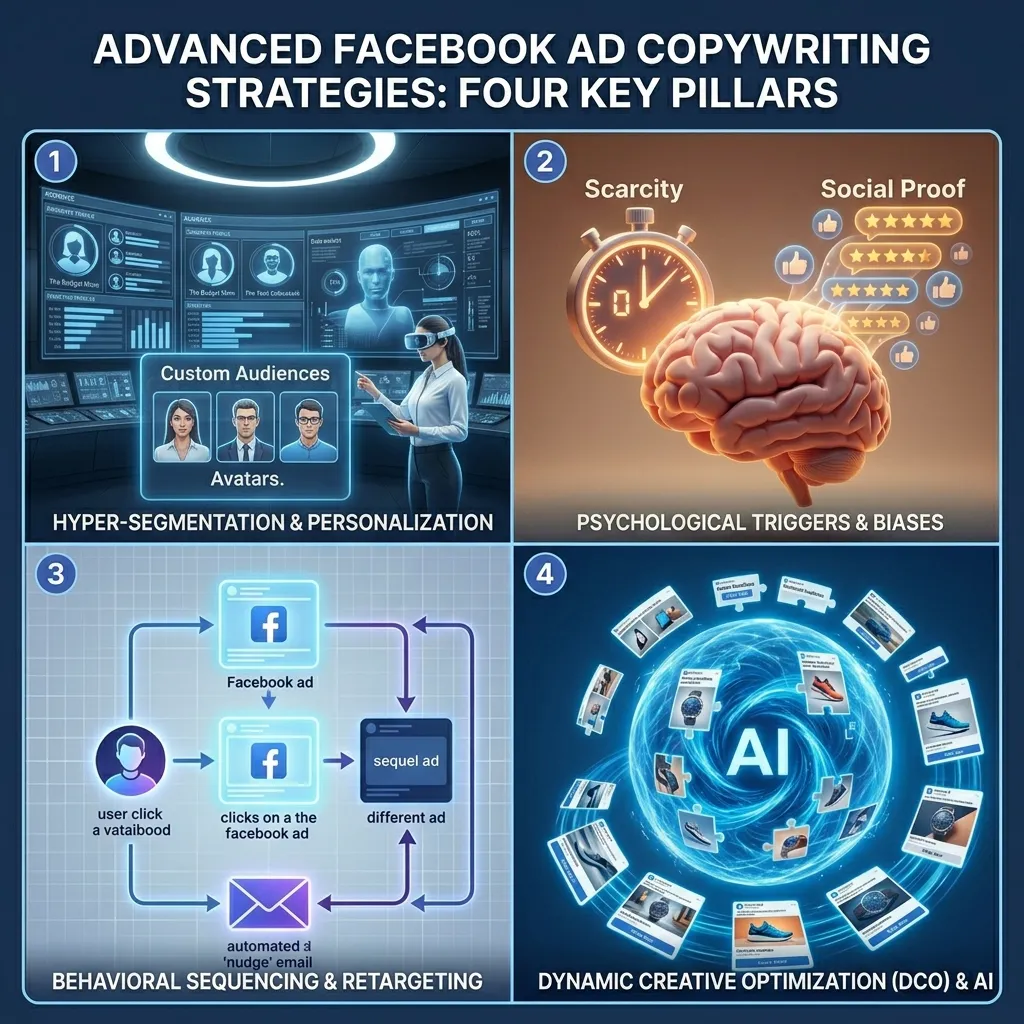
Once you’ve nailed the fundamentals, these strategies help you squeeze more performance from every campaign.
How does A/B testing improve ad performance?
A/B testing means running two versions of an ad that differ by one element—the headline, the hook, or the CTA—to see which performs better. Test one variable at a time so you know exactly what drove the change.
Over time, these small wins compound. A 10% lift here and a 15% lift there can dramatically reshape your results across a full campaign.
How do you leverage social proof and urgency?
Social proof reassures hesitant buyers. Drop in a customer quote, a star rating, or a number (“Join 12,000 happy customers”). Real evidence beats bold claims every time.
Urgency, used honestly, pushes people off the fence. Limited-time offers, low-stock alerts, and deadlines create a reason to act now instead of later. Just keep it truthful—fake urgency erodes trust quickly.
Why is storytelling so effective in ads?
Stories stick where facts slide off. A short customer story—someone who struggled, found your product, and saw results—makes your offer relatable and memorable.
You don’t need much room. Even two sentences can carry a mini-narrative: “Maria spent years dreading tax season. With our app, she filed in under an hour.” That arc creates emotional investment.
Social media copywriting: beyond the ad creative
Strong social media copywriting extends past the ad itself. Your brand voice should stay consistent across your page, your comments, and your organic posts. When people click through to your profile and see the same tone, trust deepens.
Responding to comments on your ads also matters. Quick, helpful replies signal that a real, caring brand stands behind the offer.
Optimizing for Conversions: Facebook Ad Copywriting Best Practices
Writing great copy is half the battle. These best practices help that copy perform at its peak.
Why should you write mobile-first copy?
The vast majority of Facebook users browse on their phones. That means your copy needs to work on a small screen. Front-load your most important message, keep sentences short, and break up text with line breaks.
Always preview your ad on mobile before publishing. A line that looks fine on desktop can get awkwardly cut off on a phone.
How should you use emojis and visual language?
Emojis can boost engagement when used with purpose. They add personality, draw the eye, and help organize copy into scannable sections. A few well-placed checkmarks can highlight benefits at a glance.
The key is moderation. Two or three relevant emojis enhance your message. A dozen random ones make it look like spam.
What role do landing pages play?
Your ad copy makes a promise. Your landing page must keep it. If your ad says “50% off running shoes,” the landing page should open with that exact offer—same wording, same visuals.
This message match reassures visitors they’re in the right place. A mismatch breaks trust and tanks conversions, no matter how good the ad was.
Persuasive ad copywriting techniques that work
A few reliable techniques sharpen any ad:
- Use “you” often. Speak directly to the reader, not about your company.
- Lead with benefits. Translate every feature into a real-world payoff.
- Add specificity. “Save 30 minutes a day” beats “save time.”
- Create a single focus. One offer, one CTA, one clear next step.
Analyzing and Improving Your Facebook Ad Copywriting
The best copywriters treat every ad as an experiment. Data shows you what to keep and what to cut.
Which metrics should you track?
A handful of metrics reveal how your copy is performing:
- Click-through rate (CTR): Measures how compelling your hook and headline are.
- Conversion rate: Shows whether your copy attracts the right people.
- Cost per result: Tells you how efficiently your copy turns spend into outcomes.
- Engagement (likes, comments, shares): Signals how well your message resonates.
A high CTR with a low conversion rate usually means your copy is intriguing but mismatched with your offer or landing page.
Why does iteration matter?
No ad is perfect on the first try. Continuous improvement is what separates good advertisers from great ones. Review your results weekly, pause underperformers, and double down on winners.
Keep a swipe file of your best-performing ads. Patterns will emerge that you can apply to future campaigns.
Learning from ad copy examples
Studying strong ad copy examples sharpens your instincts. Facebook’s Ad Library lets you view active ads from any brand for free. Browse competitors and admired companies to see how they hook readers and frame offers.
Don’t copy outright. Instead, note the structures and angles that work, then adapt them to your own voice and audience.
Your Journey to Facebook Ad Copywriting Mastery
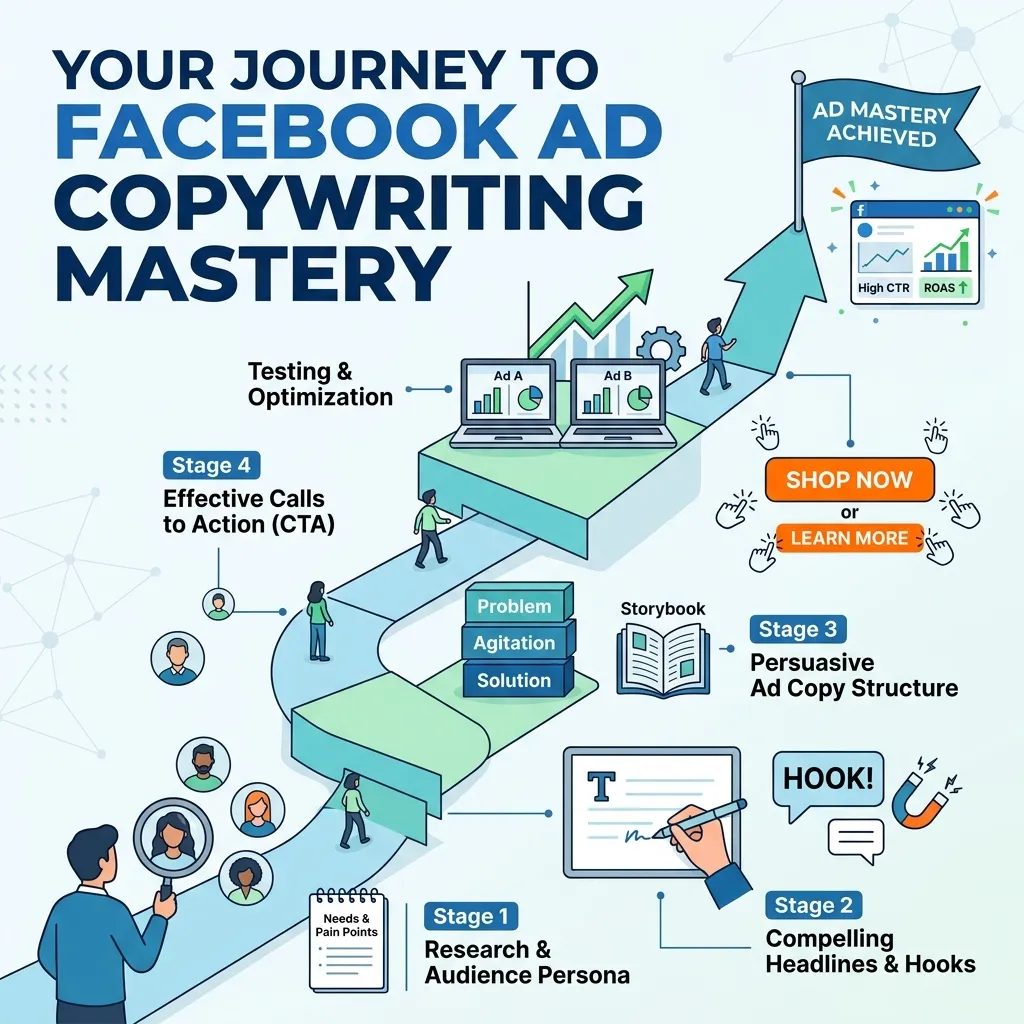
Facebook ad copywriting is a skill you build through practice, testing, and study. The fundamentals stay constant: know your audience, hook them fast, lead with benefits, and guide them to one clear action.
To recap the essentials:
- Research your audience and speak their language.
- Open with a hook that earns the “See more” click.
- Use emotion, social proof, and storytelling to persuade.
- Match your ad’s promise to your landing page.
- Test relentlessly and let the data guide you.
As privacy changes reshape targeting, copy is becoming even more important. When you can’t rely on hyper-specific targeting alone, the words you choose do the heavy lifting of finding and convincing the right people. Invest in your writing now, and you’ll stay ahead as the platform evolves.
Open Facebook’s Ad Library, study a few ads in your niche, and draft your next campaign using the PAS framework above. The best way to improve is to write, test, and refine.
Frequently Asked Questions About Facebook Ad Copywriting
What is the ideal length for Facebook Ad Copywriting?
There’s no perfect length for Facebook Ad Copywriting. Short copy works well for quick offers, while longer Facebook Ad Copywriting is better for storytelling or explaining complex products. Always make the first two lines compelling.
How do I make my Facebook Ad Copywriting stand out?
Successful Facebook Ad Copywriting starts with a strong hook, speaks directly to the audience, highlights benefits over features, and ends with a clear CTA. Consistent Facebook Ad Copywriting also reflects your brand voice.
What’s the difference between Facebook Ad Copywriting and content marketing?
Facebook Ad Copywriting is designed to generate immediate actions like clicks or sales. Content marketing focuses on educating and building trust over time. Both work together to improve marketing results.
How important is a CTA in Facebook Ad Copywriting?
A strong CTA is essential in Facebook Ad Copywriting. Clear phrases like “Shop Now” or “Start Free Trial” guide users toward the next step and improve conversion rates.
Can I use emojis in Facebook Ad Copywriting?
Yes. Emojis can improve Facebook Ad Copywriting by making ads more eye-catching and easier to scan. Use them naturally without overloading your message.
How often should I test Facebook Ad Copywriting?
You should test Facebook Ad Copywriting regularly using A/B testing. Change one element at a time, measure results, and continue optimizing your Facebook Ad Copywriting for better performance.
What are common Facebook Ad Copywriting mistakes?
Common Facebook Ad Copywriting mistakes include weak hooks, focusing on features instead of benefits, unclear CTAs, poor mobile formatting, and making unsupported claims.
How can I improve emotional Facebook Ad Copywriting?
Strong Facebook Ad Copywriting connects with emotions like trust, excitement, or relief. Focus on how your product improves people’s lives instead of simply listing features.
Where can I find Facebook Ad Copywriting inspiration?
The Facebook Ad Library is an excellent place to study successful Facebook Ad Copywriting. Analyze competitor ads, then adapt ideas while keeping your own unique brand voice.
Does Facebook Ad Copywriting help SEO?
While Facebook Ad Copywriting doesn’t directly affect search rankings, it can drive more website traffic, increase brand awareness, and support your overall digital marketing strategy.
Why is consistent Facebook Ad Copywriting important?
Consistent Facebook Ad Copywriting builds trust and strengthens your brand identity. When your ads, landing pages, and social content share the same tone, users are more likely to convert.
How can I keep Facebook Ad Copywriting ethical?
Ethical Facebook Ad Copywriting means making honest claims, avoiding misleading promises, and using real proof. Trustworthy Facebook Ad Copywriting builds long-term customer relationships and sustainable business growth.