An advertising funnel is a step-by-step framework that guides potential customers from first discovering your brand to making a purchase—and beyond. Mastering each stage through Complete Paid Advertising, optimized Landing Page Conversion Ads, and smart bidding strategies is what separates high-performing campaigns from wasted ad spend.
Every business runs ads. Not every business runs ads that actually work.
The difference usually comes down to one thing: understanding your advertising funnel. Without a clear funnel, you’re essentially throwing money at people who aren’t ready to buy, or worse, losing warm prospects right before they convert. With one, every dollar you spend has a job to do.
The advertising funnel isn’t a new concept. Marketers have used variations of it for over a century—from print campaigns to Television Advertising Success stories that shaped entire generations of consumers. But the digital age has fundamentally changed how funnels are built, measured, and optimized. Today, you have access to tools, data, and targeting capabilities that would have seemed impossible just 20 years ago.
This guide covers everything you need to know. From the foundational stages of the advertising funnel to advanced tactics for Complete Paid Advertising, Landing Page Conversion Ads, and strategies to Improve Ad Conversion Rate—you’ll walk away with a clear blueprint for building a funnel that delivers real results.
I. Introduction to the Advertising Funnel
What is an advertising funnel?
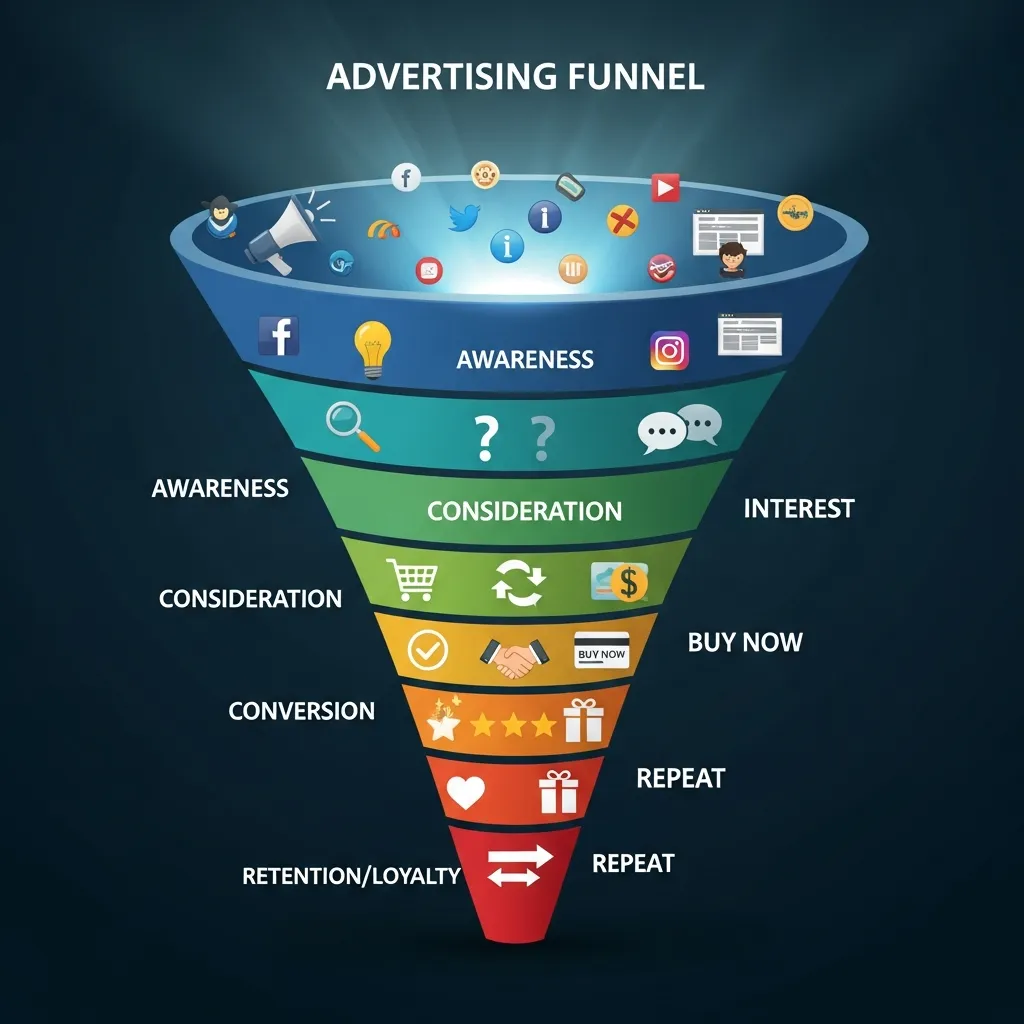
An advertising funnel is a structured marketing framework that maps the journey a potential customer takes from their first interaction with your brand to the point of conversion—and ideally, long-term loyalty. Each stage of the funnel represents a different level of intent and engagement, requiring a different approach to messaging, creative, and channel selection.
The classic funnel model follows the AIDA framework: Awareness, Interest, Desire, and Action. Modern iterations extend this to include post-conversion stages like Loyalty and Advocacy, recognizing that retaining a customer is often more valuable than acquiring a new one.
Why is an advertising funnel important for businesses?
Without an advertising funnel, marketing becomes reactive. You create ads when you need sales, target broadly, and hope for the best. A funnel flips this dynamic. It gives you a proactive, systematic approach to moving people through predictable stages of decision-making.
Practically speaking, a well-built advertising funnel helps you allocate budget more efficiently, identify where prospects are dropping off, and tailor your message to where someone actually is in their buying journey. The result? Higher Ad Conversion Rates, lower cost-per-acquisition, and more sustainable growth.
How has the advertising funnel evolved in the digital age?
The traditional advertising funnel was largely linear—a customer saw a TV ad, visited a store, and bought a product. Digital has made this journey far more complex and non-linear. A customer might discover your brand on Instagram, research you on Google, read a blog post, see a retargeting ad, and then convert via email—all within a week.
This evolution has made Complete Paid Advertising strategies more sophisticated. Brands can now target users at every stage of the funnel with precision, using behavioral data, lookalike audiences, and AI-driven optimization to serve the right message at exactly the right moment.
II. Stages of the Advertising Funnel
Awareness Stage: How do you cast a wide net and reach new audiences?
The top of the funnel is where everything begins. At this stage, your goal isn’t to sell—it’s to be seen.
Strategies for building brand awareness include paid social campaigns on Meta and TikTok, YouTube pre-roll ads, display advertising, and programmatic placements. These channels prioritize reach over intent, making them ideal for introducing your brand to cold audiences.
Content types for the awareness stage should be easy to consume and emotionally engaging. Short-form video, eye-catching static ads, and educational content all perform well here. The goal is to create a memorable first impression.
Metrics to track for awareness include impressions, reach, video view rate, and brand recall lift. Don’t judge awareness campaigns by conversion rate—that metric belongs further down the funnel.
Interest and Consideration Stage: How do you engage audiences who already know your brand?
Once someone knows you exist, the next challenge is making them care.
Cultivating interest means providing content that speaks directly to your audience’s problems and goals. Comparison guides, explainer videos, webinars, and case studies all work well here. The aim is to position your brand as the most credible solution to a specific problem.
Driving engagement requires meeting your audience where they spend time. Retargeting ads are particularly powerful at this stage—you can serve tailored content to people who’ve already visited your website or engaged with your social content.
Measuring interest and engagement means tracking metrics like click-through rate (CTR), time on page, pages per session, and social engagement rate. A rising CTR with a high bounce rate often signals a mismatch between your ad creative and your landing page.
Desire Stage: How do you nurture leads and build genuine purchase intent?
This is where prospects move from “I’m interested” to “I want this.”
Building desire through your value proposition means clearly communicating what makes your offer better than the alternatives—not just what it does, but why it matters. Testimonials, reviews, before-and-after comparisons, and ROI calculators are all effective tools here.
Personalized communication and offers play a major role at this stage. Dynamic ads that show products a user has already browsed, personalized email sequences, and exclusive offers for engaged prospects all accelerate movement through the funnel.
Qualifying leads involves identifying which prospects have the highest purchase intent. Lead scoring models, behavior-based triggers, and engagement thresholds can help sales and marketing teams prioritize where to focus their efforts.
Action and Conversion Stage: How do you optimize Landing Page Conversion Ads for maximum results?
This is the stage where money is either made or lost.
Optimizing Landing Page Conversion Ads starts with alignment. Your ad copy and your landing page must tell the same story—same offer, same tone, same visual language. Disconnects between the two are one of the most common causes of high click-through rates paired with poor conversion rates.
Beyond message match, your landing page itself needs to be fast (Google recommends under 2.5 seconds for Largest Contentful Paint), mobile-optimized, and free of unnecessary distractions. A single, focused call-to-action will almost always outperform a page cluttered with multiple options.
CTAs that convert are specific, benefit-oriented, and create urgency without feeling manipulative. “Start your free 14-day trial” converts better than “Click here.” “Get my free quote” outperforms “Submit.” The language you use in your CTA is often the smallest change with the biggest impact on Ad Conversion Rate.
Post-conversion strategies include order confirmation emails, onboarding sequences, upsell flows, and cross-sell campaigns. The conversion isn’t the end of the funnel—it’s the beginning of the loyalty stage.
Loyalty and Advocacy Stage: How do you retain customers and turn them into brand advocates?
Acquiring a new customer costs 5–7 times more than retaining an existing one, according to research by Frederick Reichheld of Bain & Company. That statistic alone makes the loyalty stage worth investing in seriously.
Building loyalty requires consistent value delivery after the sale. This includes exceptional customer service, loyalty programs, exclusive subscriber offers, and regular touchpoints that remind customers why they chose you.
Encouraging advocacy and referrals turns your best customers into your most effective marketers. Referral programs, user-generated content campaigns, and review generation strategies all leverage word-of-mouth at scale—a channel that no paid advertising budget can fully replicate.
III. Building a Complete Paid Advertising Strategy for Your Funnel
Choosing the right platforms for each stage of the advertising funnel
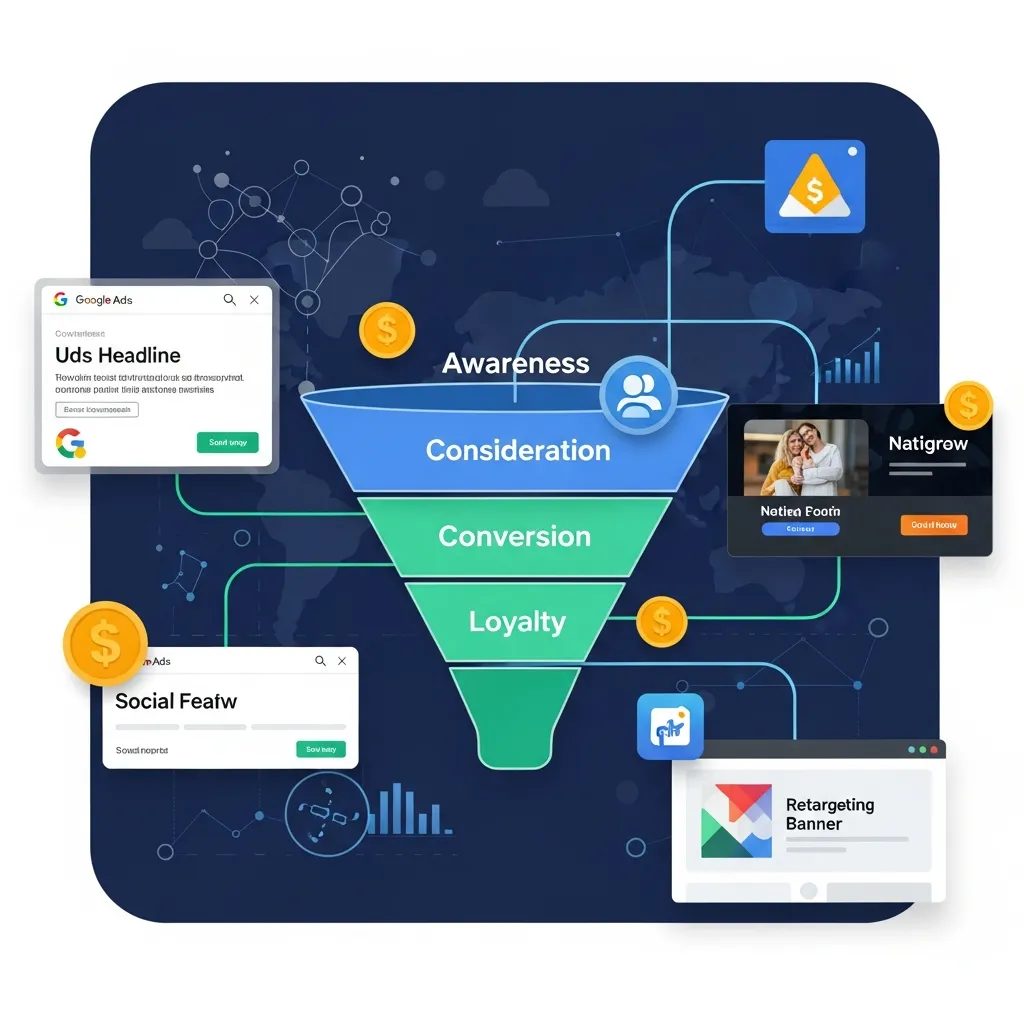
Platform selection should be guided by audience intent and behavior, not personal preference. Google Ads excels at capturing bottom-of-funnel intent—people actively searching for solutions. Meta (Facebook and Instagram) and TikTok are stronger for top-of-funnel brand building, where you’re reaching people before they know they need you.
A Complete Paid Advertising strategy uses multiple platforms in concert, matching the right channel to the right funnel stage rather than concentrating spend in one place.
How do you craft compelling ad copy and creatives for each funnel stage?
Top-of-funnel creative should prioritize emotion and memorability. Bottom-of-funnel creative should prioritize clarity and urgency. The mistake most brands make is using the same creative across all funnel stages—which inevitably means the message is wrong for most of the audience seeing it.
Test multiple creative formats: static images, short-form video (under 15 seconds), carousel ads, and user-generated content. Different formats resonate differently depending on platform, audience, and funnel stage.
Budgeting and bidding strategies for a Complete Paid Advertising approach
A general rule of thumb is to allocate 60–70% of your paid budget to lower-funnel campaigns where purchase intent is highest, and 30–40% to upper-funnel awareness campaigns that feed the pipeline. This ratio will shift based on your industry, sales cycle, and business goals.
For bidding, automated strategies like Target CPA and Target ROAS work well once your campaigns have sufficient conversion data (generally 30–50 conversions per month). Before that threshold, manual CPC bidding gives you more control while your data accumulates.
How do you measure ROI across a Complete Paid Advertising funnel?
Single-touch attribution models (last click, first click) will always misrepresent the value of upper-funnel campaigns. Data-driven attribution, which Google Ads offers natively, distributes conversion credit across all touchpoints in the customer journey—giving a far more accurate picture of which campaigns are actually driving ROI.
IV. Optimizing Your Advertising Funnel for Success
A/B testing and experimentation best practices
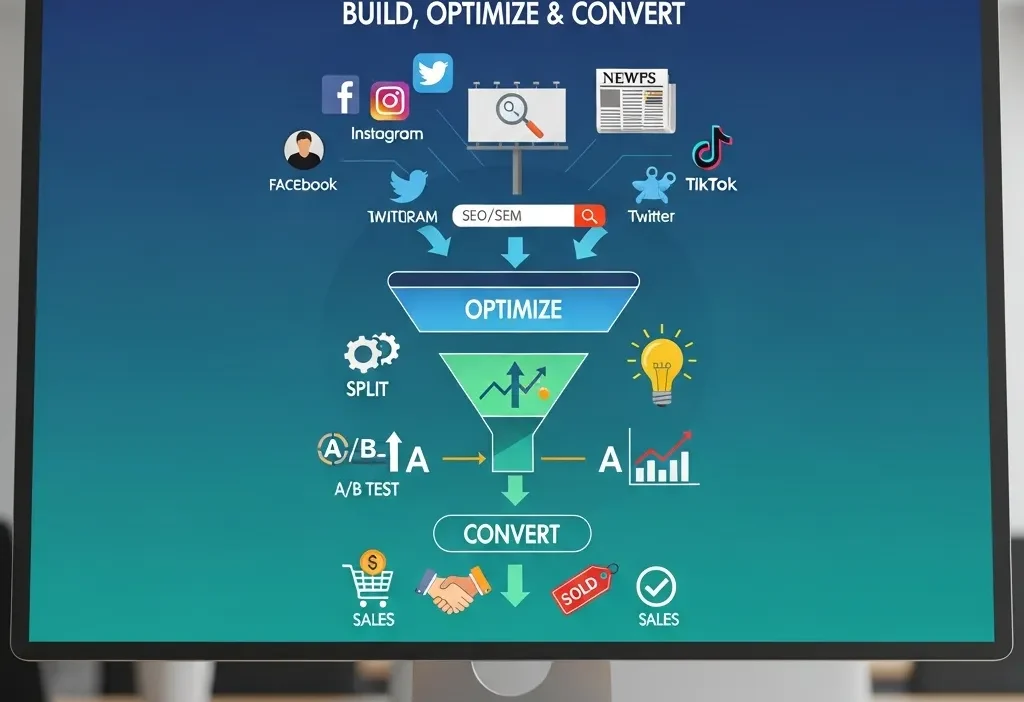
Never test multiple variables simultaneously—isolate one element at a time (headline, image, CTA, audience) to identify what’s actually driving performance differences. Run tests for a minimum of 2 weeks to account for day-of-week variation, and ensure you have statistical significance before declaring a winner.
How can you use data analysis to Improve Ad Conversion Rate?
Start by identifying your biggest drop-off points. Use funnel visualization tools in Google Analytics 4 to see where users abandon the conversion path. A high CTR with a low landing page conversion rate signals a creative-to-page mismatch. A high add-to-cart rate with a low purchase rate suggests friction in your checkout process.
Fixing the right bottleneck will always deliver a higher return than optimizing a stage that’s already performing well. To Improve Ad Conversion Rate, focus your energy where the leakage is largest.
The role of marketing automation in funnel optimization
Marketing automation platforms like HubSpot, Klaviyo, and ActiveCampaign allow you to trigger personalized communications based on user behavior—automatically. An abandoned cart sequence, a lead nurture drip, or a post-purchase loyalty flow can all run without manual intervention, ensuring no prospect falls through the cracks.
V. Lessons from Television Advertising Success Applied to Digital Funnels
What can digital marketers learn from Television Advertising Success?
Television Advertising Success was built on three pillars: storytelling, emotional resonance, and consistent repetition. These principles don’t become less relevant in digital—they become more important, because the competition for attention is fiercer.
The most effective digital advertising funnels borrow from TV’s playbook. They open with a hook that creates immediate emotional engagement, tell a clear story arc across their funnel stages, and repeat their core brand message consistently enough that it sticks.
How do you reach a broad audience effectively without a TV budget?
Television’s greatest advantage was reach—the ability to put your message in front of millions simultaneously. Digital platforms now offer comparable reach at a fraction of the cost. YouTube’s TrueView ads, Meta’s Reach objective campaigns, and programmatic display networks all allow brands to build broad awareness without a broadcast budget.
Building brand trust and recognition across the advertising funnel
Consistency builds trust. Using the same brand colors, tone of voice, and core message across every touchpoint—from a top-of-funnel awareness ad to a post-purchase email—creates the cumulative brand recognition that Television Advertising Success was famous for delivering.
VI. The Future of the Advertising Funnel: AI and Personalization

How is AI transforming the advertising funnel through predictive analytics?
AI-powered predictive analytics can identify which prospects are most likely to convert before they show overt purchase signals. Tools like Google’s Performance Max and Meta’s Advantage+ Shopping campaigns use machine learning to automatically allocate budget toward the highest-value users across the funnel—reducing manual optimization workload while improving performance.
What is hyper-personalization, and how does it apply to each funnel stage?
Hyper-personalization goes beyond inserting a first name into an email. It means dynamically tailoring ad creative, landing page content, and offers based on a user’s behavior, location, device, and purchase history. At the awareness stage, this might mean showing different creative to users in different cities. At the conversion stage, it might mean surfacing the specific product category a user browsed on their last visit.
What emerging technologies will shape the future of advertising funnels?
Conversational AI, augmented reality ads, and zero-party data strategies are among the most significant emerging forces. As third-party cookies continue to phase out, brands that build direct data relationships with their customers—through quizzes, preference centers, and loyalty programs—will have a meaningful competitive advantage in personalizing their advertising funnels.
Conclusion
The advertising funnel isn’t just a marketing framework—it’s the operational backbone of any serious growth strategy. Understanding where your prospects are in their journey, and meeting them with the right message at the right moment, is what transforms ad spend from a cost center into a revenue engine.
The principles covered in this guide apply whether you’re running a lean startup with a modest budget or a scaled enterprise with a full media team. Start with your funnel stages. Audit where your prospects are dropping off. Build a Complete Paid Advertising strategy that matches your channel mix to each stage. Optimize your Landing Page Conversion Ads for message match and speed. And commit to the ongoing process of testing, measuring, and iterating—because the brands that Improve Ad Conversion Rate consistently aren’t the ones that find a magic tactic. They’re the ones that never stop refining.
The tools are available. The data is there. The only question is how effectively you put it all together.
Frequently Asked Questions (FAQs)
What is an advertising funnel?
An advertising funnel is a strategic framework that maps the journey a potential customer takes from first discovering your brand to making a purchase and becoming a loyal advocate. Each stage requires different messaging, creative formats, and channel selection to move prospects closer to conversion.
How many stages are in a typical advertising funnel?
Most advertising funnels include five core stages: Awareness, Interest/Consideration, Desire, Action/Conversion, and Loyalty/Advocacy. Some simplified models use three stages (Top, Middle, and Bottom of Funnel), while more advanced models may include additional post-purchase stages.
What is Complete Paid Advertising in the context of a funnel?
Complete Paid Advertising refers to a holistic paid media strategy that covers every stage of the advertising funnel—not just bottom-of-funnel conversion campaigns. It includes awareness-stage reach campaigns, mid-funnel retargeting, and conversion-focused ads, all working together across multiple platforms.
How can I improve my Landing Page Conversion Ads?
To improve Landing Page Conversion Ads, ensure your ad copy and landing page share the same message, offer, and visual language. Minimize page load time, remove distracting navigation, use a single focused CTA, and A/B test headlines and page layouts. Message match between ad and page is the single highest-impact improvement most advertisers can make.
What are effective strategies to Improve Ad Conversion Rate?
To Improve Ad Conversion Rate, start by identifying your largest drop-off point using funnel analytics. Common tactics include tightening message match between ads and landing pages, strengthening your CTA copy, adding social proof (reviews, testimonials), reducing form fields, and improving mobile page speed. Test one change at a time to isolate what’s driving improvement.
How does an advertising funnel relate to overall marketing strategy?
The advertising funnel is one component of a broader marketing strategy. It focuses specifically on how paid and organic advertising moves prospects through the buying journey. It works in concert with content marketing, SEO, email marketing, and CRM to create a cohesive, multi-channel customer acquisition system.
Can small businesses benefit from using an advertising funnel?
Absolutely. Small businesses often see the biggest ROI gains from adopting a funnel approach because it forces budget discipline—spending on campaigns that serve a specific purpose rather than running unfocused awareness ads with no clear path to conversion. Even a simple two-stage funnel (awareness + retargeting) can significantly Improve Ad Conversion Rate for businesses with limited budgets.
What are the key metrics to track at each stage of the advertising funnel?
At the awareness stage, track impressions, reach, and video view rate. At the interest/consideration stage, track CTR, time on page, and engagement rate. At the desire stage, track lead quality and email open rates. At the conversion stage, track conversion rate, cost-per-acquisition, and Landing Page Conversion Ads performance. At the loyalty stage, track customer lifetime value (LTV), repeat purchase rate, and Net Promoter Score (NPS).
How can I apply principles of Television Advertising Success to my digital campaigns?
Apply Television Advertising Success principles by leading with emotional storytelling rather than feature lists, maintaining consistent brand identity across all touchpoints, and investing in repetition—ensuring your target audience sees your message frequently enough for it to create lasting recall. These principles are as effective in digital advertising as they were in broadcast.
What role does content play in the advertising funnel?
Content fuels every stage of the advertising funnel. At the top, educational and entertaining content builds awareness. In the middle, comparison guides and case studies build consideration. At the bottom, testimonials and demos reduce purchase friction. Post-purchase content like onboarding emails and tutorials support retention and advocacy.
How do I optimize my funnel for better results?
Funnel optimization is an ongoing process. Start by mapping your current funnel and identifying the stage with the highest drop-off rate. Run structured A/B tests on that stage. Analyze the data, implement the winning variation, and then move to the next bottleneck. Continuous iteration—rather than one-time fixes—is what produces compounding improvements over time.
What are the most common mistakes to avoid when building an advertising funnel?
The most common mistakes include: targeting cold audiences with bottom-of-funnel conversion ads, using the same creative across all funnel stages, failing to align Landing Page Conversion Ads with ad messaging, neglecting post-conversion retention, relying on last-click attribution, and not allocating budget to upper-funnel awareness campaigns that feed the pipeline.