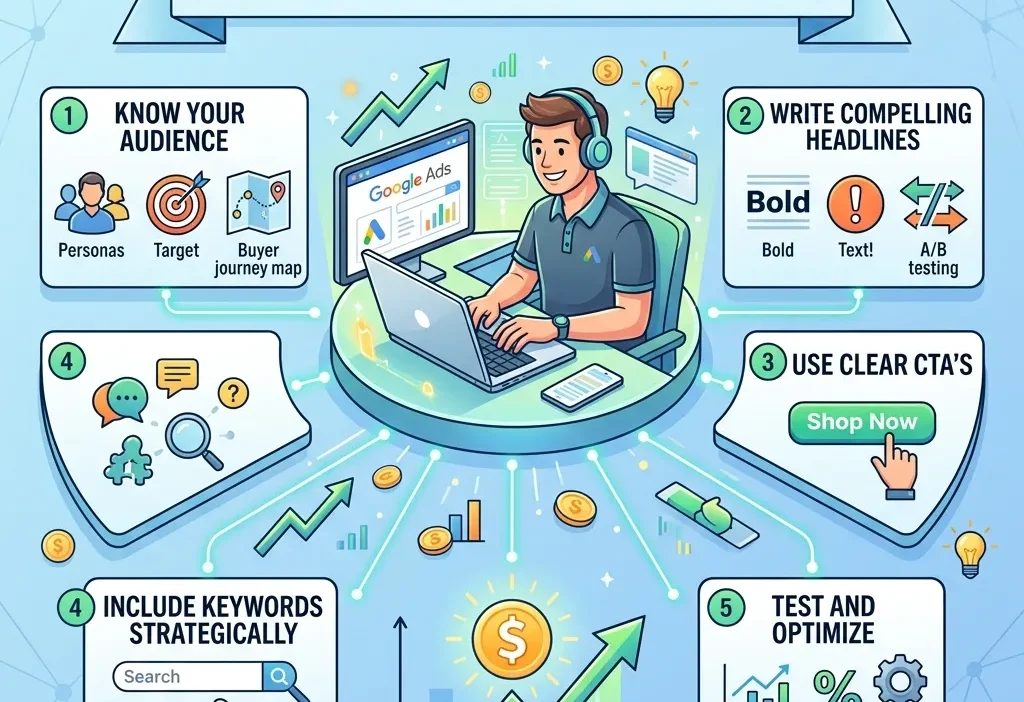
Google Ads copywriting is the craft of writing short, persuasive ad text that matches what people search for and pushes them to click. Strong copy combines relevant keywords, a clear value proposition, and a compelling call to action—then improves through continuous A/B testing and performance tracking.
Every day, billions of searches flow through Google. Each one is a moment of intent—someone looking for an answer, a product, or a solution. Your ad has a split second to win that attention. That’s where Google Ads copywriting earns its keep.
Good Google Ads copywriting does more than fill character limits. It speaks directly to a searcher’s need, signals relevance, and gives them a reason to act now rather than later. The difference between a 2% click-through rate and a 10% one often comes down to word choice, structure, and psychology.
This guide breaks down the principles, techniques, and tools behind effective Google Ads copywriting. You’ll learn how to craft headlines that hook, write descriptions that convert, optimize for different ad formats, and compare Google with Facebook ad copywriting. By the end, you’ll have a practical framework you can apply to your next campaign.
Why Is Google Ads Copywriting the Foundation of Digital Advertising Success?
Paid search remains one of the highest-intent channels in digital marketing. Unlike social ads, which interrupt users mid-scroll, Google Ads meet people who are actively searching for something. The copy is the bridge between that search and your landing page.
Google Ads copywriting works within tight constraints. A responsive search ad gives you 15 headlines (30 characters each) and four descriptions (90 characters each). Within those limits, you must communicate relevance, build trust, and motivate action. Mastering this discipline pays off across every paid campaign you run.
What Are the Core Principles of Persuasive Ad Copywriting for Google Ads?
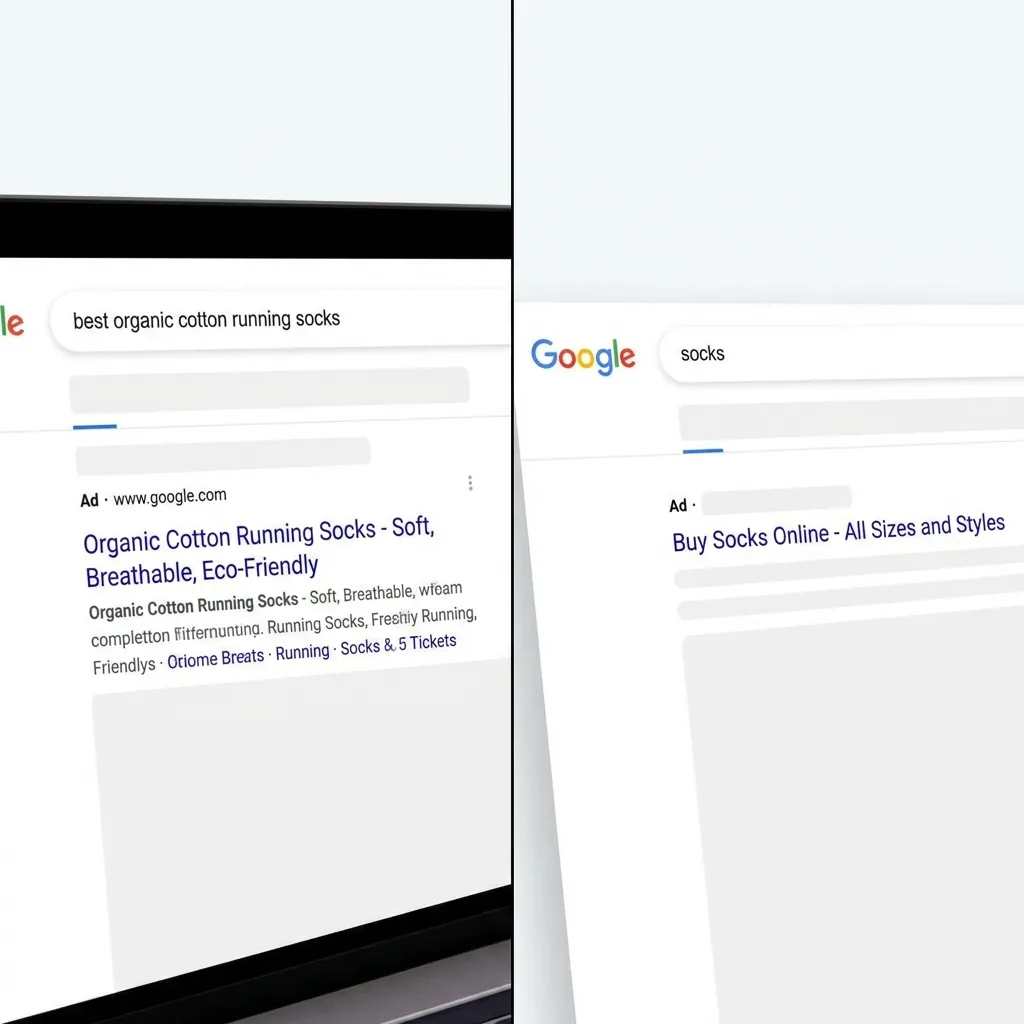
Persuasive ad copywriting blends psychology with precision. You’re not writing for awards—you’re writing to change behavior. The best Google Ads copywriting follows a few reliable principles that hold true across industries.
The Psychology Behind Effective Google Ads Copy
People click ads for emotional and practical reasons. They want to solve a problem, avoid a loss, or gain something valuable. Effective Google Ads copywriting taps into these motivations directly.
Three psychological drivers matter most:
- Relevance: Searchers want confirmation they’ve found the right answer. Mirroring their search query reassures them instantly.
- Specificity: Concrete numbers and details (“Save 30% on your first order”) feel more credible than vague claims (“Great savings”).
- Reduced friction: Words like “free,” “instant,” and “no commitment” lower the perceived risk of clicking.
What Are the Key Elements of High-Converting Google Ads?
Every high-converting ad shares a common anatomy. While the wording changes, the structure stays consistent:
- A keyword-rich headline that matches search intent
- A clear value proposition that explains the benefit
- Social proof or credibility signals (ratings, customer counts, awards)
- A strong call to action that tells the reader exactly what to do
- Ad extensions that add useful links, prices, or details
When these elements align, your ad earns higher relevance scores from Google, which lowers your cost per click and improves your position.
How Do You Craft Compelling Headlines and Descriptions for Google Ads?
Headlines do the heavy lifting in any ad. Google research shows headlines drive the majority of clicks, so this is where your sharpest Google Ads copywriting belongs.
The Art of the Hook: Grabbing Attention in Limited Space
You have 30 characters per headline. That’s roughly five or six words to stop a scroll and earn a click. Every word must work hard.
Try these proven hooks:
- Lead with the benefit: “Cut Hiring Time in Half”
- Ask a relevant question: “Tired of Slow Software?”
- Use numbers: “Join 10,000+ Happy Users”
- Address the searcher directly: “Find Your Perfect Plan”
Descriptions then expand on the promise. Use the 90 characters to add detail, reinforce credibility, and end with a nudge toward action.
How Do You Leverage Keywords for Maximum Impact and Relevancy?
Keywords are central to Google Ads copywriting because they connect your ad to the user’s search. When your headline includes the exact term someone typed, Google often bolds it in the results—drawing the eye and signaling relevance.
Place your primary keyword in at least one headline and one description. But don’t stuff. Awkward keyword cramming hurts readability and conversion. The goal is natural alignment between search query, ad copy, and landing page. This three-way match raises your Quality Score, which directly affects how much you pay.
What Role Do Calls to Action (CTAs) Play in Google Ads Copywriting?
A call to action turns interest into movement. Without a clear next step, even a brilliant ad leaves money on the table.
Driving Conversions: From Click to Customer
The best CTAs are specific and benefit-oriented. Compare “Submit” with “Get My Free Quote”—the second tells the reader exactly what they’ll receive. Strong CTA verbs include:
- Get, Start, Try, Claim, Discover, Book, Shop, Download
Match your CTA to where the user sits in the funnel. Someone researching options responds well to “Compare Plans,” while a ready-to-buy searcher reacts to “Order Today.”
How Do You A/B Test CTAs for Optimal Performance?
A/B testing removes guesswork from Google Ads copywriting. Run two versions of an ad that differ by a single element—say, “Start Free Trial” versus “Try It Free”—and let the data decide.
Test one variable at a time so you know what caused the change. Give each test enough impressions to reach statistical confidence before declaring a winner. Then roll the winning CTA into new tests. This loop of constant refinement is how top advertisers keep improving.
How Do You Optimize Google Ads Copy for Different Ad Formats?
Not all ad formats reward the same approach. Tailoring your Google Ads copywriting to the format boosts performance.
Responsive Search Ads: Maximizing Your Message
Responsive search ads (RSAs) let you supply up to 15 headlines and four descriptions. Google’s machine learning then mixes and matches combinations to find what performs best for each search.
To get the most from RSAs:
- Write headlines that make sense in any order
- Vary the angle—benefits, features, social proof, offers
- Include your keyword in some headlines, but pin sparingly
- Avoid repeating the same idea across multiple headlines
The more distinct, high-quality assets you provide, the more combinations Google can test.
Display Ads and Their Unique Copywriting Demands
Display ads appear across websites, apps, and YouTube—often to people who aren’t actively searching. That changes the copywriting job. Here, your text competes with surrounding content for attention.
Display copy should be visual-first and benefit-driven. Keep headlines punchy, pair them with a clear CTA, and lean on emotional appeal more than keyword matching. Because intent is lower, your copy must generate interest, not just confirm it.
Google Ads vs. Facebook Ads Copywriting: What’s the Difference?
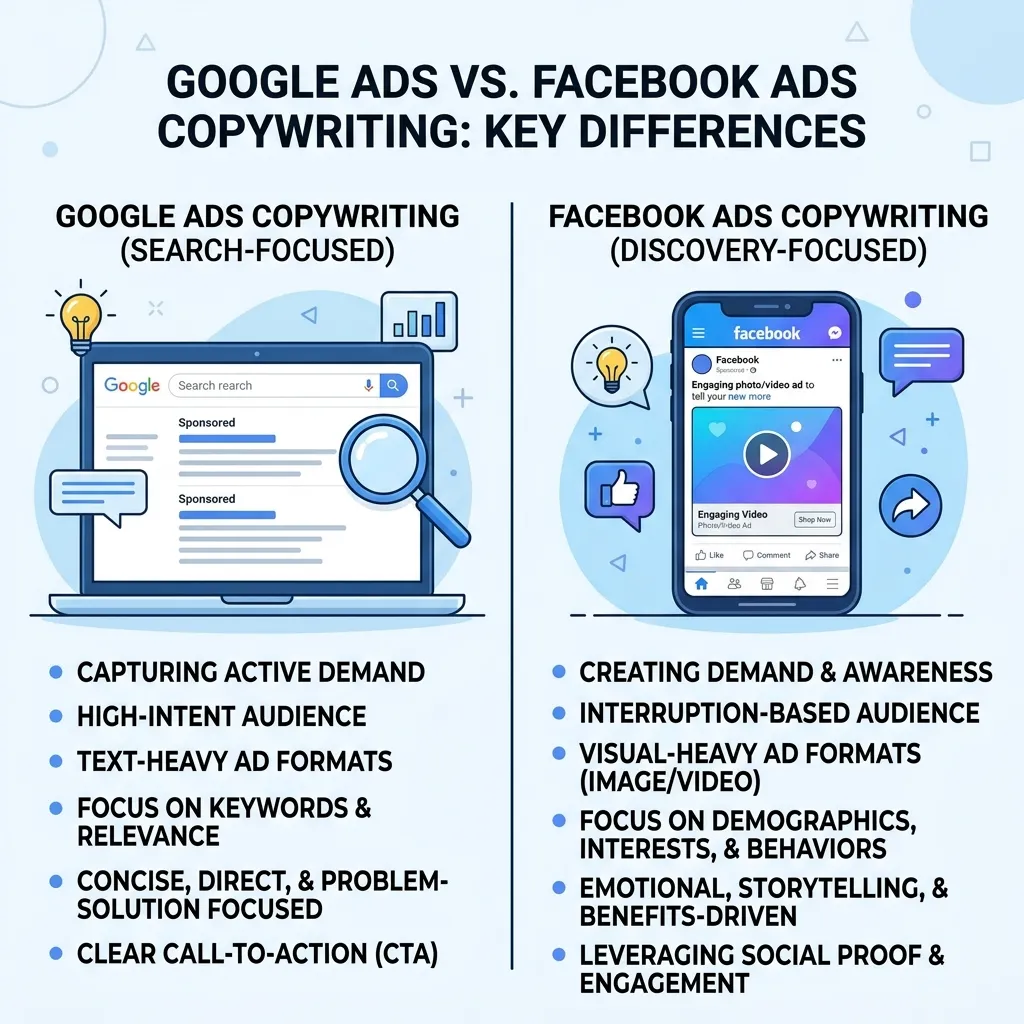
The Google Ads vs Facebook Ads debate comes up in nearly every marketing strategy session. Both platforms demand persuasive ad copywriting, but the context differs sharply.
Understanding Platform-Specific Nuances
The core distinction is intent. Google captures active demand—people search because they already want something. Facebook ad copywriting creates demand, interrupting users to spark interest they didn’t arrive with.
This shapes the writing:
- Google Ads copy is concise, keyword-led, and intent-matching. It answers a question fast.
- Facebook ad copywriting is story-led, visual, and emotion-driven. It earns attention before making the pitch.
Best Practices for Each Platform
For Google, prioritize keyword relevance, clear value, and a direct CTA. For Facebook, open with a scroll-stopping hook, use conversational language, and pair copy with strong creative. A formal Google headline might read “Affordable CRM Software—Free Trial,” while the same offer on Facebook could start with “Still tracking leads in a spreadsheet? There’s a better way.”
How Does Hybrid Advertising in Digital Marketing Combine Google and Facebook Ads?
Hybrid advertising in digital marketing uses both platforms together to cover the full customer journey. Facebook builds awareness and demand; Google captures it when buyers start searching.
Synergistic Strategies for Cross-Platform Success
A smart hybrid advertising in digital marketing approach treats the two channels as partners. Use Facebook to introduce your brand and seed interest. Then, when those users search your category on Google, your ads are there to close the deal.
Retargeting strengthens this loop. Someone who clicked a Facebook ad but didn’t convert can be served a tailored Google display ad later, keeping your brand top of mind.
Maintaining Brand Voice Across Different Channels
Consistency builds trust. Even though Google Ads copywriting and Facebook ad copywriting differ in style, your brand voice, key messages, and value propositions should stay aligned. A customer who hears one promise on Facebook and a different one on Google feels confused—and confused buyers rarely convert.
What Are Advanced Google Ads Copywriting Techniques?
Once you’ve mastered the fundamentals, advanced techniques can sharpen your edge.
Incorporating Urgency and Scarcity
Urgency pushes people to act now instead of “later” (which usually means never). Phrases like “Offer Ends Sunday,” “Only 3 Left,” or “Sale Ends Tonight” create a fear of missing out. Use real deadlines and real limits—false scarcity erodes trust and can violate Google’s policies.
Emotional Triggers in Ad Copy
People justify decisions with logic but make them with emotion. Strong Google Ads copywriting taps feelings like ambition, relief, belonging, or security. A line such as “Sleep Easy with 24/7 Protection” sells peace of mind, not just a product feature.
How Do You Measure and Improve Google Ads Copy Performance?
You can’t improve what you don’t measure. Tracking the right metrics turns Google Ads copywriting from guesswork into a repeatable system.
Key Metrics for Success
Watch these numbers closely:
- Click-through rate (CTR): How often people who see your ad click it
- Conversion rate: How many clicks become customers or leads
- Quality Score: Google’s 1–10 rating of ad relevance and quality
- Cost per conversion: What you pay for each meaningful action
CTR tells you whether your copy grabs attention. Conversion rate tells you whether it attracts the right people.
Iterative Optimization: A Continuous Process
Great campaigns are never “finished.” Review performance regularly, pause weak ads, and double down on winners. Feed insights from one test into the next. This iterative habit compounds over time, steadily lowering costs and lifting returns.
What Is the Future of Google Ads Copywriting?

Automation and personalization are reshaping how ads get written and served.
Leveraging AI for Enhanced Copy Creation
AI writing tools now generate, test, and refine ad variations at scale. They help marketers produce dozens of headline options in seconds, spot winning patterns, and adapt copy to search trends. The human role shifts toward strategy, brand voice, and editing—while AI handles volume.
Hyper-Personalization at Scale
Personalization is moving beyond simple keyword insertion. Future Google Ads copywriting will tailor messages to user context—location, device, time of day, and past behavior—delivering the right words to the right person at the right moment. Advertisers who embrace this will see stronger relevance and higher returns.
Conclusion
Google Ads copywriting is part art, part science. The art lies in crafting words that connect emotionally and persuade. The science lives in keywords, testing, and metrics that prove what works. Master both, and your ads will earn more clicks at a lower cost.
Start with the fundamentals: match your copy to search intent, lead with benefits, and end with a clear call to action. Layer in advanced tactics like urgency and emotional triggers. Then measure relentlessly and refine through A/B testing. Whether you run Google alone or pursue hybrid advertising in digital marketing across Google and Facebook, consistent, data-driven copy is your path to growth.
Pick one campaign this week. Rewrite its headlines using the principles above, set up an A/B test, and watch what the data reveals. That single step is how mastery begins.
Frequently Asked Questions
What is Google Ads copywriting?
Google Ads copywriting is the practice of writing short, persuasive text for ads that appear on Google’s search and display networks. It focuses on matching user search intent, including relevant keywords, and driving clicks and conversions within strict character limits.
How do I write good Google Ads copy?
Start by understanding your audience’s search intent. Include your primary keyword in the headline, lead with a clear benefit, add credibility signals like ratings or customer counts, and finish with a specific call to action. Then test variations to find what performs best.
What are the key elements of a successful Google Ad?
A successful Google Ad has a keyword-rich headline, a clear value proposition, credibility signals such as reviews or social proof, a strong call to action, and relevant ad extensions. Together these raise your Quality Score and lower your cost per click.
How is Google Ads copywriting different from Facebook ad copywriting?
Google Ads copywriting targets active searchers, so it’s concise and keyword-led. Facebook ad copywriting interrupts users who aren’t searching, so it’s story-led, visual, and emotion-driven. Google confirms existing demand; Facebook creates new demand.
Can I use the same ad copy for Google and Facebook?
No. The Google Ads vs Facebook Ads contrast means each platform needs its own approach. Google rewards short, intent-matching copy, while Facebook rewards conversational, scroll-stopping hooks. You can reuse the core message, but the wording and tone should differ.
What is persuasive ad copywriting?
Persuasive ad copywriting is writing that motivates a specific action—clicking, signing up, or buying. It uses psychological drivers like relevance, specificity, urgency, and emotion to change reader behavior within a small space.
How important are keywords in Google Ads copy?
Very important. Keywords connect your ad to a user’s search and help Google judge relevance. Including the search term in your headline often makes it bold in results and improves your Quality Score, which lowers your costs.
What is a good click-through rate (CTR) for Google Ads?
A good CTR varies by industry, but a search campaign averaging 3–5% is generally healthy, and top performers exceed that. Compare your CTR against your own industry benchmarks rather than a single universal number.
How often should I update my Google Ads copy?
Review your ad copy at least every few weeks. Refresh underperforming ads, test new variations regularly, and update copy whenever you launch promotions, change offers, or notice a drop in performance.
What are responsive search ads?
Responsive search ads (RSAs) let you provide up to 15 headlines and four descriptions. Google’s machine learning then tests different combinations automatically to show the best-performing mix for each search query.
How can AI help with Google Ads copywriting?
AI tools can generate multiple headline and description variations quickly, identify high-performing patterns, and adapt copy to search trends. This speeds up creation and testing, freeing marketers to focus on strategy, brand voice, and editing.
What are some common mistakes to avoid in Google Ads copy?
Avoid keyword stuffing, vague CTAs like “Submit,” ignoring search intent, using the same copy across platforms, making false urgency claims, and failing to test variations. Each of these lowers relevance, trust, or conversion rates.